GX 339-4 doesn't sleep for long: new outburst detected with LCO / XB-NEWS
ATel #18141; Yasmin El Maoued, David M. Russell (NYU Abu Dhabi), Kevin Alabarta, Maria Cristina Baglio (INAF-OAB), Fraser Lewis (Faulkes Telescope Project & The Schools' Observatory, Astrophysics Research Institute, LJMU), D. M. Bramich, Yi-Jung Yang, Dalya Akl, Mokhine Motsoaledi, Sandeep Rout (NYU Abu Dhabi), Payaswini Saikia (Yale)
on 4 Nov 2026; 11:56 UT
Credential Certification: David M. Russell (dave.russell5@gmail.com)
Subjects: Optical, X-ray, Binary, Black Hole, Transient
The black hole low-mass X-ray binary GX 339-4 is a transient system that typically has an outburst every 1-3 years. The last outburst started in August 2025 (ATel #17327, #17330, #17484). The source was in a fading hard state in February 2026, as observed with Swift/XRT (ATel #17653). From June 2026 onwards, it was no longer detected at radio frequencies with MeerKAT, when the outburst likely ended (ATel #18015).
We have been monitoring the source at optical wavelengths since 2007 with the Las Cumbres Observatory (LCO;
Brown et al. 2013) 2-m and 1-m robotic telescopes, in particular the 2-m Faulkes Telescope South (e.g. ATel #1586, #2270, #7434, #10797, #13113, #17327). Analysis of the LCO data is achieved using the real-time data analysis pipeline, the ''X-ray Binary New Early Warning System'' (XB-NEWS); see Russell et al. (2019) and Saikia et al. (2026) for details.
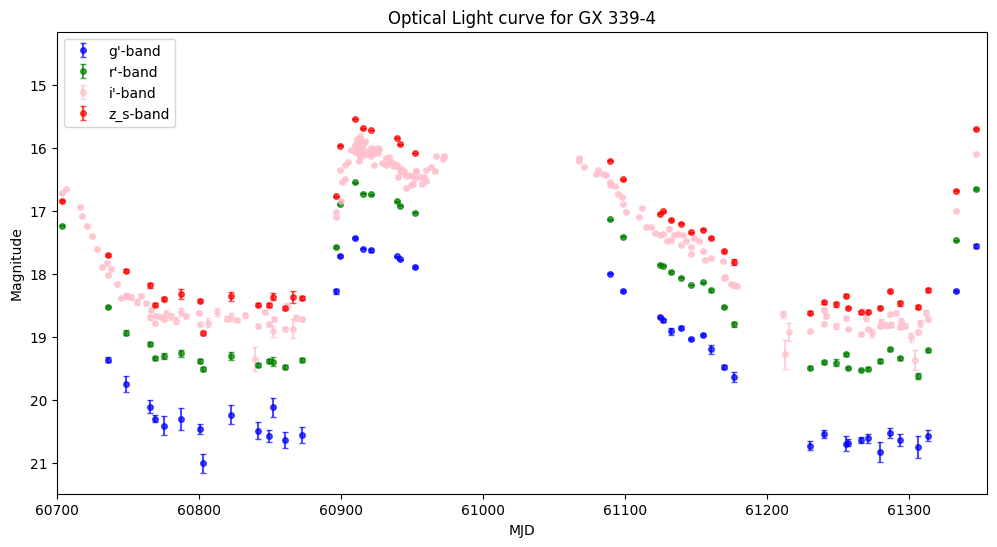
The previous outburst of GX 339-4 was last detected with LCO on MJD 61179 (19 May 2026), followed by a period of quiescence from MJD 61211 (20 June 2026) to MJD 61313 (30 September 2026). During this interval, the average quiescent magnitudes (in SDSS filters) were g' = 20.65 +/- 0.09, r' = 19.41 +/- 0.13, i' = 18.82 +/- 0.18, and z_s = 18.48 +/- 0.12. A new brightening of the source was detected on MJD 61333 (20 October 2026; g' = 18.27, r' = 17.47, i' = 17.00, and z_s = 16.68), followed by a further increase in brightness on MJD 61347 (3 November 2026; g' = 17.56, r' = 16.66, i' = 16.10, and z_s = 15.70), implying that the new outburst is already ~3 mag above the quiescent level (magnitude errors during this new outburst phase are 0.01-0.03). The most recent magnitudes are similar to the peak of the previous outburst, although the source could brighten further. A light curve covering the last few years is linked below.
We note that this latest observation was obtained at an airmass of 1.9, and that the source will very soon be Sun-constrained for the coming months, limiting visibility for ground-based optical-IR telescopes. We therefore encourage multi-wavelength (including space-based) observations over the coming days/weeks to monitor the new outburst. We will continue to observe the source with LCO when possible, as part of an on-going monitoring campaign of ~50 low-mass X-ray binaries (Lewis et al. 2008) with LCO and the Faulkes Telescopes. This material is based upon work supported by Tamkeen under the NYUAD Research Institute grant CG014.
LCO / XB-NEWS light curve of GX 339-4