Keck/MOSFIRE near-infrared imaging and colors of 3I/ATLAS on 2026 February 6
ATel #18133; Bryce T. Bolin (Eureka Scientific), Laura-May Abron (Griffith Observatory), Leo Alcorn (W. M. Keck Observatory), Matthew Belyakov (Caltech), Tony Connors (W. M. Keck Observatory), Ian Wong (STScI)
on 31 Oct 2026; 10:16 UT
Credential Certification: Bryce Bolin (bolin.astro@gmail.com)
Subjects: Optical, Comet, Solar System Object
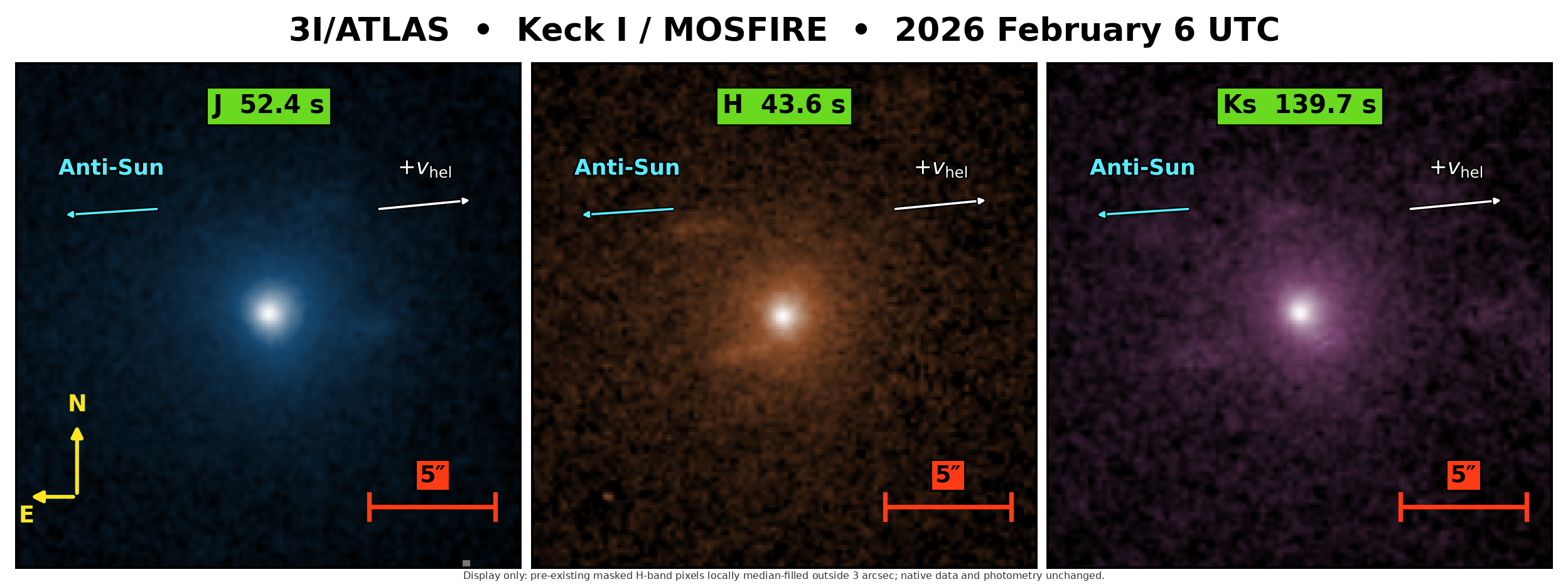
We obtained J, H, and Ks images of interstellar comet 3I/ATLAS (Bolin et al. 2025, MNRAS, 542, L139) on 2026 February 6 UTC using MOSFIRE on the 10-m Keck I telescope (2026A N045; PI I. Wong). Accepted stacks contain six, five, and sixteen exposures totaling 52.4, 43.6, and 139.7 s in J, H, and Ks. Heliocentric and geocentric distances were approximately 3.834 and 2.917 au; the phase angle was 6.2 degrees. Panels have north up and east left. Cyan Anti-Sun and white +v_hel arrows mark the projected anti-solar and positive heliocentric velocity directions at each filter's epoch; lengths are illustrative.
Within a 2.1576-arcsec-radius aperture (approximately 4565 km), native MOSFIRE Vega magnitudes are approximately J = 16.11, H = 15.77, and Ks = 15.80. Colors are J-H = 0.33 +/- 0.22, H-Ks = -0.03 +/- 0.22, and J-Ks = 0.31 +/- 0.08 mag. Errors include local uncertainty and adopted calibration sensitivities, conditional on the reference-star models. All agree with the corresponding synthetic solar colors of 0.30, 0.06, and 0.36 mag. J-Ks ranges from 0.28 to 0.31 mag for aperture radii of 1.44-3.60 arcsec. No point-source aperture correction was applied.
The J-band minor-axis FWHM is approximately 1.59 arcsec versus 1.15-1.42 arcsec for selected field stars, consistent with a resolved coma. No comparably bright stars were recovered for H or Ks.
Reduction removes additive offsets, applies flat fields, and subtracts source-masked median skies from other exposures in each band. H uses normalized same-night sky flats and raw-count masks. Images were registered on the comet and field stars subtracted while protecting the coma; the comet is recovered in all five H exposures. Reduction and aperture photometry follow 2024 YR4 (Bolin et al. 2025, ApJL, 984, L25) and 2024 PT5 (Beniyama et al. 2025, A&A, 700, A183), adapted for the resolved coma.
The two H-band reference-star zero points differ by 0.194 mag, dominating H-dependent color errors. H counts exceed the 1% linearity threshold but fall within the range characterized by up to 5% response deviation; no empirical nonlinearity correction was applied. Detector-response and shared reference-star model errors, and band-dependent PSF differences, remain unquantified and limit color-evolution tests.
Some of the data presented herein were obtained at Keck Observatory, which is a private 501(c)3 non-profit organization operated as a scientific partnership among the California Institute of Technology, the University of California, and the National Aeronautics and Space Administration. The Observatory was made possible by the generous financial support of the W. M. Keck Foundation. The raw Keck Observatory data, once public, can be accessed from the Keck Observatory Archive (KOA), operated by the W. M. Keck Observatory and the NASA Exoplanet Science Institute (NExScI), under contract with NASA.
The authors wish to recognize and acknowledge the very significant cultural role and reverence that the summit of Maunakea has always had within the Native Hawaiian community. We are most fortunate to have the opportunity to conduct observations from this mountain.
2026 February 6 UT Keck/MOSFIRE J, H, and Ks images of 3I/ATLAS