3I/ATLAS in February 2026: dust imaging and spectroscopic gas constraints from Gemini North/GMOS
ATel #18132; Bryce T. Bolin (Eureka Scientific), Ian Wong (STScI), Laura-May Abron (Griffith Observatory), Brian Lemaux (Gemini Observatory), Leila Alamos (Gemini Observatory), Kristin Chiboucas (Gemini Observatory), Erin Figura (Gemini Observatory), Christoffer Fremling (Caltech), Josef Hanuš (Charles University), Oleksandra Ivanova (Astronomical Institute of Slovak Academy of Sciences), Eunchong Kim (Gemini Observatory), Ludmilla Kolokolova (University of Maryland), Jen Miller (Gemini Observatory)
on 31 Oct 2026; 03:38 UT
Credential Certification: Bryce Bolin (bolin.astro@gmail.com)
Subjects: Optical, Solar System Object
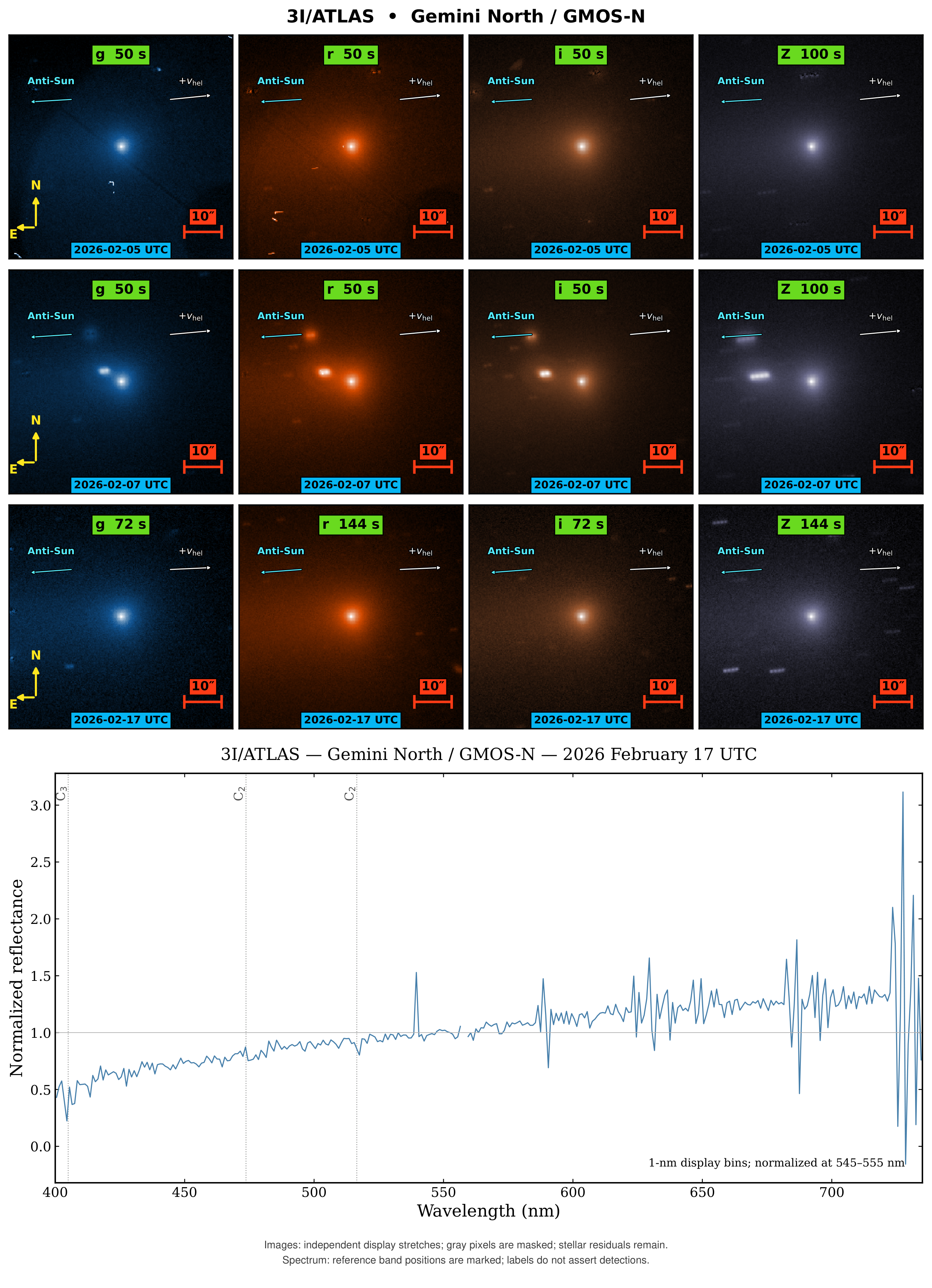
We obtained g, r, i, and Z imaging of interstellar comet 3I/ATLAS (Bolin et al. 2025, MNRAS, 542, L139) on 2026 February 5, 7, and 17 UTC with GMOS on the 8.1-m Gemini North telescope (T15). Programs were GN-2025B-DD-102 on February 5/7 and GN-2025B-FT-113 on February 17 (PI B. Bolin). The images show extended dust through February 17. North is up and east left; cyan Anti-Sun and white +v_hel arrows show projected anti-solar and positive heliocentric velocity directions at each filter's epoch, with illustrative lengths.
In 10,000-km-radius apertures, accepted approximate SDSS (g,r,i,z) magnitudes are (17.27 +/- 0.13, 16.62 +/- 0.10, 16.41 +/- 0.10, 16.33 +/- 0.10) on February 7 and (18.17 +/- 0.12, 17.40 +/- 0.10, 17.16 +/- 0.10, 17.05 +/- 0.10) on February 17. Aperture radii are 4.67 and 4.06 arcsec at geocentric distances of 2.954 and 3.398 au. Corresponding g-r = 0.65 +/- 0.17 and 0.77 +/- 0.17 mag, and r-i = 0.22 +/- 0.14 and 0.24 +/- 0.14 mag.
Assuming dust-dominated r flux and the Halley-Marcus phase correction, A(0)f(rho) = 569 +/- 54 and 471 +/- 43 cm on February 7 and 17. Contamination-sensitive February 5 g/r photometry is excluded from the primary color comparison. Errors include noise and calibration sensitivities, excluding unknown comet passband errors and cross-epoch calibration covariance.
February 5/7 integrations were 50 s each in g/r/i and 100 s in Z; February 17 had 72 s each in g/i and 144 s each in r/Z. February 17 B480+ spectra used 540/550 nm settings, 500 s each, and a 1-arcsec slit.
Continuum subtraction and band analysis follow Bolin et al. (2021, AJ, 161, 116; P/2019 LD2) and Bolin et al. (2024, MNRAS, 527, L42; C/2022 E3). Neither CN nor C2 emission is established. With a fixed outflow speed of 0.5 km s-1 and extraction-matched Haser (1957, Bull. Acad. R. Belg. Cl. Sci., 43, 740) models, residual-adjusted 3-sigma envelopes give Q(CN) < 6.9 E25 and Q(C2) < 1.7 E25 molecules s-1. These conditional bounds span tested continuum/fluorescence models and 40-/80-pixel full slit extractions; they are not complete confidence limits. For the 40-pixel extraction, F(C3) < 6.21 E-15 erg cm-2 s-1 is a conditional band-flux bound, not a validated total C3 production limit.
Nondetections alone do not establish decline from ATels #17561, #17719, and #17841. Scale lengths and C2 g-factors follow Cochran et al. (2012, Icarus, 218, 144), Cochran (1985, AJ, 90, 2609), and Cochran et al. (1992, Icarus, 98, 151); epoch-dependent CN g-factors follow Schleicher (2010, AJ, 140, 973).
Gemini Observatory is a program of NSF's NOIRLab, operated by AURA under cooperative agreement with NSF for the Gemini partnership. We acknowledge the astronomical and cultural significance of Maunakea and the privilege of observing there.
2026 February 5, 7, and 17 UT Gemini/GMOS images and February 17 spectrum of 3I/ATLAS