Spectroscopic Classification of PNV J19450648+1822422 as an Fe II-type Nova with Concurrent Photometry
ATel #18012; Jingyuan Zhao (Shandong Astronomical Society), Jiashuo Zhang (Xuzhou Foreign Language School), Wang Li (Taizhou Institute of Science and Technology, NJUST), Yaozhang Ou (Wuyi University), Ezhar Elijan (Wuhan University), Xinyan Chen (Nanjing University of Aeronautics and Astronautics)
on 26 Aug 2026; 14:28 UT
Credential Certification: Kirill Sokolovsky (kirx@scan.sai.msu.ru)
Subjects: Optical, Cataclysmic Variable, Nova, Transient
The NMW-TexasTech survey (Rokinon 135-mm f/2.2 telephoto lens + QHY600PH-M CMOS camera) discovered an optical transient of 9.0 mag in Sagitta on 2026 Aug 25.1278 UTC, and reported it to the CBAT Transient Objects Confirmation Page, where it was designated PNV J19450648+1822422 http://www.cbat.eps.harvard.edu/unconf/followups/J19450648+1822422.html Its possible progenitor star is Gaia DR3 1824166210904571136. ATel #18008 reports spectroscopic observations suggesting that this transient is likely a classical nova, with its spectrum dominated by absorption lines. ATel #18009 reports follow-up photometric observations.
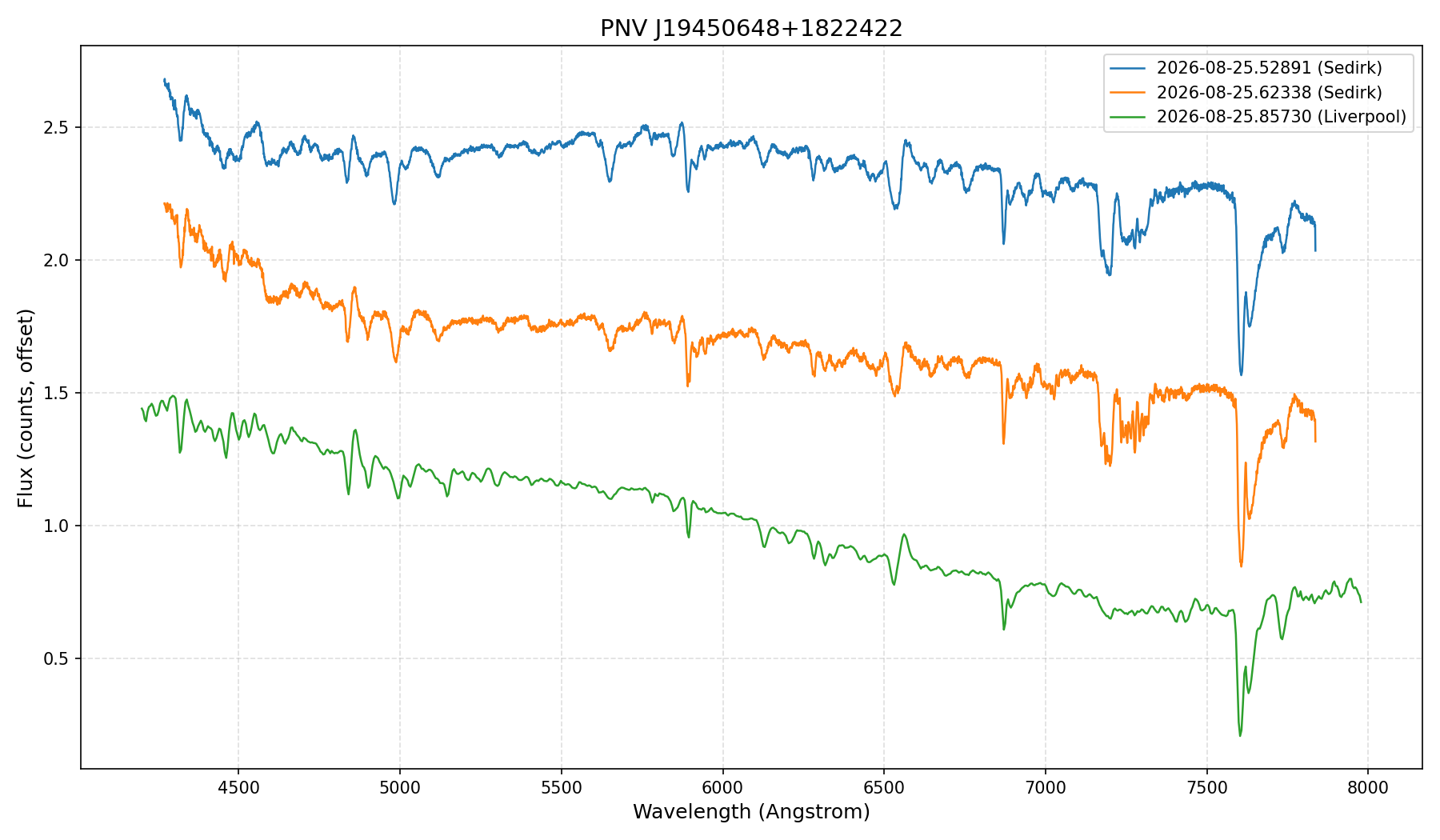
We obtained spectra at two epochs using a modified UVEX-4 spectrograph mounted on a Celestron C11 telescope, together with a Toup ATR585M camera, at Sedirk Observatory (Yancheng, Jiangsu, China) on 2026 Aug 25.52819 UTC and 25.62338 UTC. The two spectra were stacked from 7x600-s and 5x600-s exposures, respectively.
The spectra from the two epochs are broadly similar, showing numerous absorption lines likely originating from the pseudophotosphere, such as Na I D 5890, 5896, and also exhibiting Balmer lines (H_alpha, H_beta, H_gamma) with P Cygni profiles. However, in our second-epoch spectrum, conspicuous blended Fe II 4515, 4520, and 4522 emission lines, and a possible weak Fe II 4923 emission feature, have emerged. These features were not prominent in either the ATel #18008 or our first-epoch spectrum.
Furthermore, as part of the PATAG proposal AL26A01, we obtained a spectrum (stacked from 5x10-s exposures) of the transient using the SPRAT spectrograph (R~350; Piascik et al. 2014) on the 2-m Liverpool Telescope (Steele et al. 2004) on 2026 Aug 25.85730 UTC.
In the Liverpool Telescope spectrum, Fe II 4923 became apparent, and additional emission lines also appeared, such as Fe II 4550, 4576, and 5169. We measure the FWHM of the H_alpha emission component to be ~900 km/s. Based on these features, we classify this transient source as an Fe II-type nova (Williams 1992).
We also performed photometric observations using a Toup GS350AR 58-mm f/6 guide scope equipped with a QHY miniCAM8M monochrome CMOS camera at Sedirk Observatory, through Sloan g' r' i' z' filters with 3-second exposures. Ensemble aperture photometry was calibrated against field stars from ATLAS-REFCAT2 (Tonry et al. 2018). The photometric results are listed below.
Date (UTC)   |   mag   |   Error   |   Filter
2026-08-25.53208   |   7.501   |   0.036   |   g'
2026-08-25.65818   |   7.361   |   0.036   |   g'

2026-08-25.53192   |   7.162   |   0.036   |   r'
2026-08-25.65696   |   6.970   |   0.036   |   r'

2026-08-25.53263   |   7.119   |   0.036   |   i'
2026-08-25.63564   |   7.009   |   0.036   |   i'
2026-08-25.65561   |   6.959   |   0.036   |   i'

2026-08-25.53247   |   7.094   |   0.052   |   z'
2026-08-25.65678   |   6.849   |   0.053   |   z'
The photometry indicates that the transient continued to brighten during our observations, by approximately 0.14-0.25 mag across the g' r' i' z' bands over an interval of about three hours.
Further observations are strongly encouraged.
Based on observations made with the Liverpool Telescope operated on the island of La Palma by Liverpool John Moores University in the Spanish Observatorio del Roque de los Muchachos of the Instituto de Astrofisica de Canarias with financial support from the UK Science and Technology Facilities Council.
Spectra of PNV J19450648+1822422