VLA radio detection of Nova Sagittae 2026 (V488 Sge)
ATel #18088; Kirill Sokolovsky, Justin Linford (NRAO), Laura Chomiuk, Peter Craig (MSU), Katie Barnhart, Darien Perla, Pragati Acharya, John Worley, Anthony Pearce, Vallia Antoniou, Elias Aydi (TTU), Jennifer Sokoloski (Columbia), Koji Mukai (NASA/GSFC)
on 3 Oct 2026; 19:36 UT
Credential Certification: Kirill Sokolovsky (kirx@scan.sai.msu.ru)
Peaking at visual magnitude 7 around 2026-08-25.9 UT and being
(so far) the brightest classical nova of the year,
Nova Sagittae 2026 (V488 Sge, PNV J19450648+1822422) has been
the target of optical photometric and spectroscopic (CBET #5729,
ATel #18008, #18009, #18012, #18014, #18021, #18022, #18033,
#18053) as well as X-ray observations (ATel #18028, #18084).
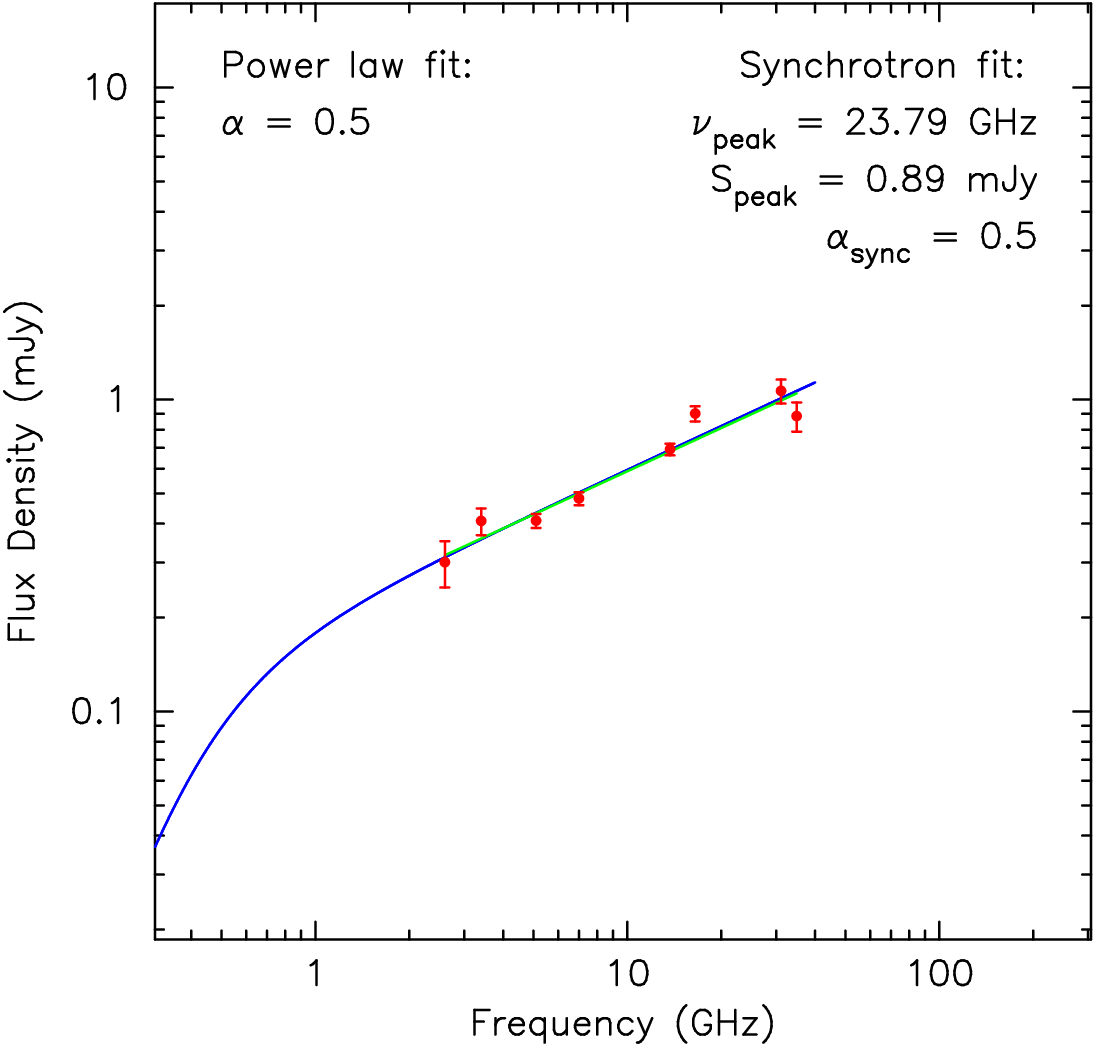
We report 2.6-35 GHz radio observations of V488 Sge with
the Karl G. Jansky Very Large Array (VLA) in its most compact D
configuration. The nova was not detected on 2026-09-03.04 (8 days
after the optical peak), was detected at 31 and 35 GHz (~0.3 mJy)
on 2026-09-08.99 (14 days), and was clearly detected at all
frequencies on 2026-09-25.98 (31 days). The measured flux
densities, their one-sigma errors and three-sigma upper limits
are listed below:
# epoch 1  2026-09-03.04
# nu(GHz) S(mJy)
2.6      <0.177
3.4      <0.102
5.1      <0.069
7.0      <0.069
13.7     <0.078
16.5     <0.084
31.1     <0.207
34.9     <0.201

# epoch 2  2026-09-08.99
# nu(GHz) S(mJy)  S_err(mJy)
2.6      <0.165
3.4      <0.102
5.1      <0.063
7.0      <0.060
13.7     <0.087
16.5     <0.093
31.1      0.268   0.081
34.9      0.306   0.081

# epoch 3  2026-09-25.98
# nu(GHz) S(mJy)  S_err(mJy)
2.6       0.301   0.051
3.4       0.408   0.040
5.1       0.409   0.021
7.0       0.482   0.023
13.7      0.693   0.030
16.5      0.902   0.050
31.1      1.066   0.094
34.9      0.885   0.095
An extragalactic radio source 1932+204 was used as the phase
referencing calibrator, while 3C286 was used to set
the flux density scale.
The radio spectrum of V488 Sge on 2026-09-25.98 is inverted with
a spectral index of +0.5. The shape of the spectrum is likely
determined by free-free absorption in the nova ejecta and does not
discriminate between thermal and synchrotron origin of
the emission.
VLA spectrum of V488 Sge