Optical counterpart of the black hole candidate X-ray binary MAXI J1750-327 / EP J175003.0-324244
ATel #17971; D. M. Russell, D. M. Bramich, D. Akl, Y. J. Yang (NYU Abu Dhabi), K. Alabarta, M. C. Baglio (INAF-OAB), P. Saikia (Yale)
on 15 Aug 2026; 22:47 UT
Credential Certification: David M. Russell (dave.russell5@gmail.com)
Subjects: Optical, X-ray, Binary, Black Hole, Transient
Referred to by ATel #: 17977, 17978, 17979, 17988, 17990, 17993, 18004, 18010, 18024, 18026, 18069
We report optical observations of the region of the new X-ray transient MAXI J1750-327 / EP J175003.0-324244 with the Las Cumbres Observatory (LCO). After the initial announcement of the new transient by MAXI (ATel #17963) and Einstein Probe (ATel #17964), we requested 300-second exposures in SDSS g' and i ' filters with the 1m LCO network. Images were acquired on 2026-08-13 at 20:56-21:07 UT (MJD 61265.9), and on 2026-08-14 at 20:55-21:00 UT (g'-band only) and 21:25-21:36 UT (MJD 61266.9), all with a 1m LCO telescope at the South African Astronomical Observatory (SAAO), Sutherland, South Africa.
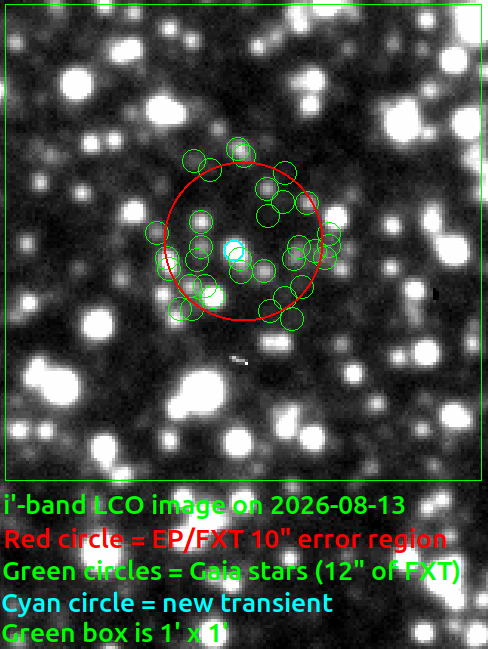
Within the 10" error circle recently reported by the FXT instrument on Einstein Probe (ATel #17969), several stars are visible. In the i '-band images, about a dozen stars are detected. All except one are consistent with positions of stars listed in the Gaia catalogue. There are 21 Gaia catalogued stars within the 10" error circle (some of which are not detected in the LCO images), with mean Gaia magnitudes that span G = 17.1 - 21.1. A new, relatively bright star is visible near the centre of the FXT error region, which does not exist in archival DSS images, nor in the Gaia catalogue. It is also absent from archival 1m LCO images taken using the Bessel I-band filter (180-sec exposure) in July 2024.
Our LCO images were processed, and magnitudes were extracted and calibrated using a real-time data analysis pipeline, the "X-ray Binary New Early Warning System" (XB-NEWS; see Russell et al. 2019, Saikia et al. 2026 for details).
The position of the new optical source was estimated, using an astrometric solution based on Gaia DR2 source positions using astrometry.net to be:
R.A. = 267.51266 (17:50:03.038),
Dec. = -32.71262 (-32:42:45.43) (J2000),
with an approximate, conservative systematic error of << 0.2".
The magnitudes of the source (in the AB magnitude system), calibrated by XB-NEWS using the ATLAS-REFCAT2 photometric catalogue (Tonry et al. 2018) are:
MJD 61265.9 : g' = 18.500 +/- 0.012, i ' = 16.545 +/- 0.005,
MJD 61266.9 : g' = 18.277 +/- 0.008 and 18.272 +/- 0.008, i ' = 16.342 +/- 0.004.
The closest Gaia star to the position of the source is Gaia DR3 4043486107474470784, at R.A. = 267.51245, Dec. = -32.71291 (~1.5" south-west of the transient), with a mean Gaia magnitude of G = 18.85, which on visual inspection could be blended with the transient (and could contribute some flux to the above magnitudes), although this star is much fainter than the new source. The magnitude of the quiescent counterpart of the new transient is unknown, but given that it does not appear in the Gaia catalogue, it is probably G > 21. The source has therefore brightened by at least ~2.7 mag. Within 24 hours between the two dates, the source brightened by 0.23 mag in g' and 0.20 mag in i '.
The hard X-ray spectrum and possible type-C QPO suggest that the nature of the source is a black hole X-ray binary in the rising stage of its discovery outburst (ATel #17969). The optical magnitude, taking into account the Galactic absorption (nH ~ 1e22 cm^-2; ATel #17964, #17969), is typical of Galactic low-mass X-ray binaries in outburst, and so is consistent with this interpretation. Multi-wavelength observations are encouraged, especially at longer wavelengths (radio to infrared), to monitor the activity and confirm the nature of this transient. A link to the optical finding chart is below. We will continue to monitor the source with LCO.
LCO optical finding chart for MAXI J1750-327