Daily photometric and spectroscopic monitoring of Nova Tau 2026 (=TCP J05210763+2338194) through its passage at maximum brightness and early decline
ATel #17970; U. Munari (INAF Padova), P. Ochner (DFA Univ. Padova), S. Dallaporta and P. Valisa (ANS Collaboration)
on 15 Aug 2026; 09:52 UT
Credential Certification: U. Munari (ulisse.munari@oapd.inaf.it)
Subjects: Optical, Cataclysmic Variable, Nova
The transient TCP J05210763+2338194, which was discovered on 2026 Aug 06.41 UT (ATel #17947), has been renamed Nova Tau 2026 following its classification as a type FeII nova in ATel #17950 and #17960.
Since discovery, we have maintained daily monitoring of Nova Tau 2026. BVRI photometry transformed to the Landolt (2009) system has been recorded with ANS Collaboration telescope ID 0310, yielding:
     UTC            V      B-V     V-R    V-I
2026 Aug  8.109  10.688  +0.787  +0.622  +1.203
2026 Aug  9.109  10.006          +0.533  +1.079
2026 Aug 10.109   9.487          +0.577  +1.034
2026 Aug 11.109   8.950  +0.778  +0.538  +1.082
2026 Aug 12.109   8.937  +0.850  +0.537  +1.109
2026 Aug 13.109   8.978  +1.066  +0.620  +1.263
2026 Aug 14.109   9.299  +1.187  +0.815  +1.581
2026 Aug 15.080   9.679  +1.022  +0.858  +1.673
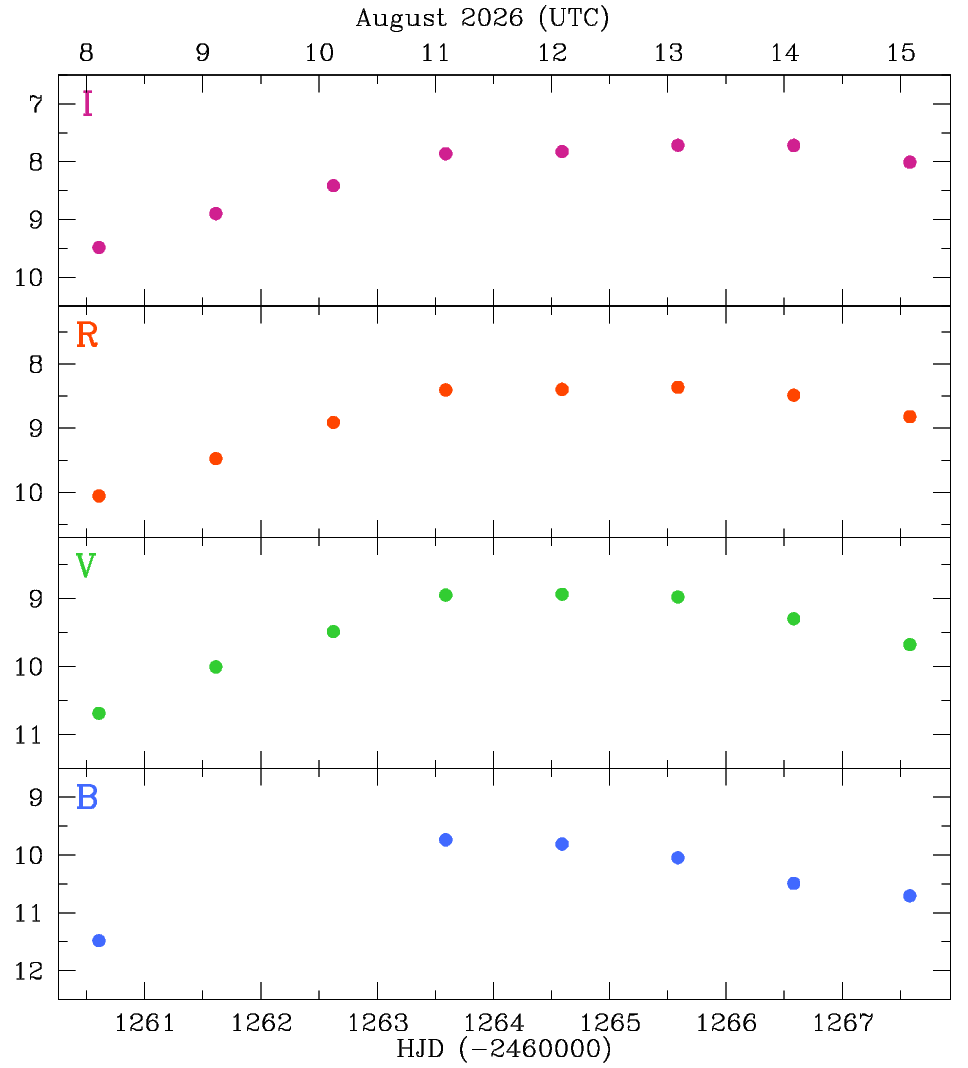
The extremely smooth resulting light curve is shown here. The maximum
occurred in sequence from B to I, as listed in the table below, where the UT and magnitude at maximum come from a parabolic fit to the data:
   UT Aug   mag
B   11.69  9.746
V   12.25  8.920
R   12.66  8.323
I   13.22  7.683
The difference of 1.53 days between the time of maximum brightness in the B and I bands, while typical, is slower than the 1.0 days observed in Nova Aql 2009 (Munari et al. 2010, PASP 122, 898) or the 1.2 days in Nova Sgr 2011b (Munari et al. 2015, MNRAS 447, 1661), both characterized by larger expansion velocities compared to Nova Tau 2026.
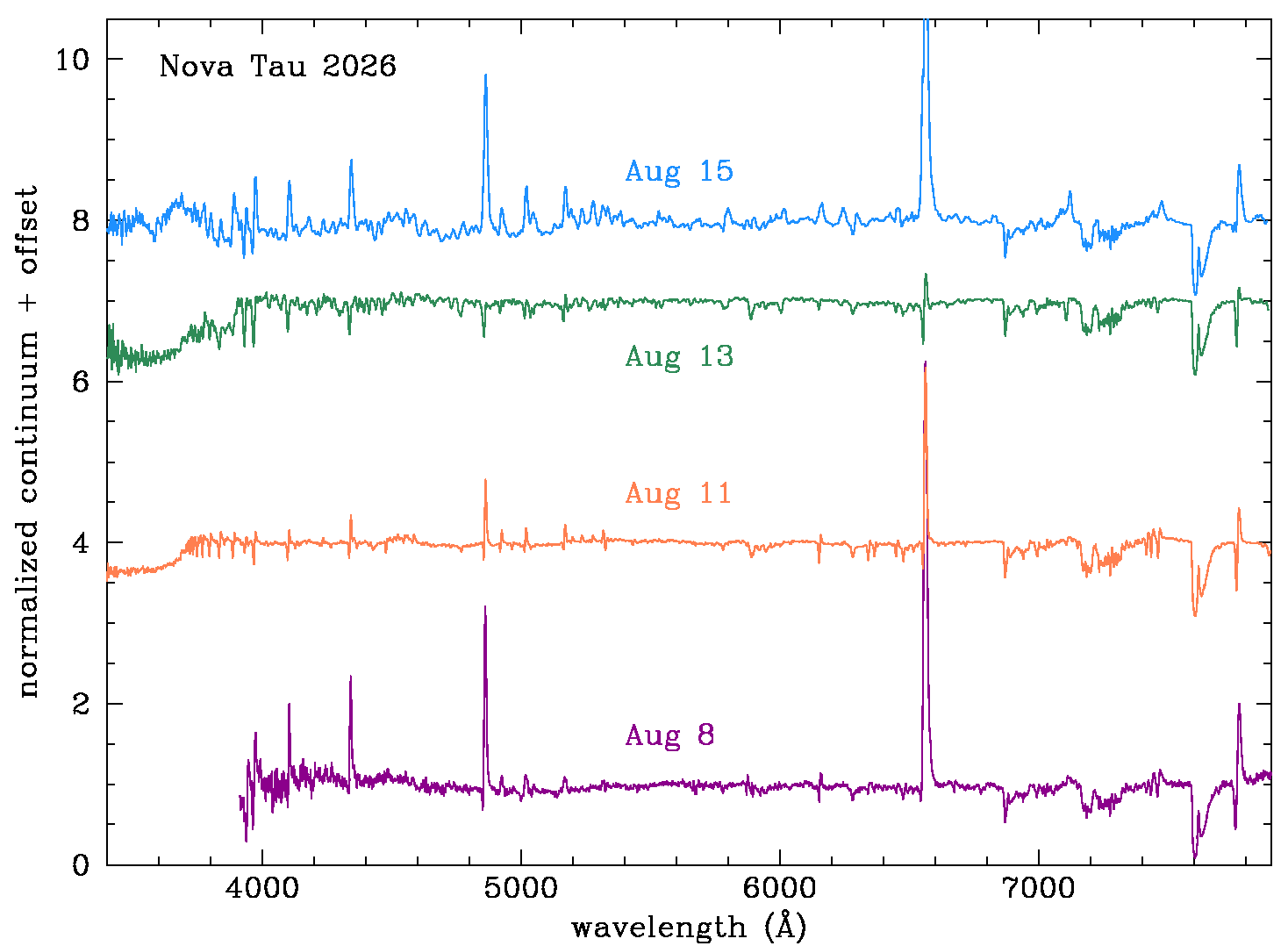
Low-resolution spectra of Nova Tau 2026 have been collected with the Asiago 1.22m (range 3200-7900 Ang, dispersion 2.31 Ang/pix) and Varese 0.84m (3820-9200 Ang, 1.42 Ang/pix) telescopes, and calibrated against nightly spectrophotometric standards. The spectral evolution is presented here, and is typical of FeII-type novae. The higher ionization conditions of the first spectrum (cf. ATel #17950) can be ascribed to progressive cooling during initial fireball expansion, while the minimum intensity of emission lines occurred simultaneously with the maximum in the I band on Aug 13.1 UT, when only weak Halpha persisted in emission. On the latest spectrum from Aug 15.1 UT, the emission lines are dominated primarily by Balmer and FeII, with contributions from OI and CII; all P-Cyg absorptions, which were strong closer to peak brightness, have disappeared (with a feeble exception for OI 7772). The integrated flux of Halpha emission is 2.0e-11, 2.4e-11, 3.8e-12, and 6.0e-11 erg/cm2/sec on Aug 8.1, 11.1, 13.1, and 15.1, respectively.
A high-resolution Echelle spectrum of Nova Tau 2026 (range 4000-9300 Ang, res. power 15,000) was obtained with the Varese 0.84m on Aug 13.1 UT, at the time of peak brightness in the I band and minimum Halpha emission. On this Echelle spectrum, Halpha shows an emission component of FWHM=580 km/s, flanked by a P-Cyg absorption of FWHM=360 km/s blue-shifted by 290 km/s from the emission line. The only other line present in (very weak) emission is OI 7772, with an emission FWHM=320 km/s, and a P-Cyg absorption with FWHM=270 km/s blue-shifted by 280 km/s.
The reddening affecting the nova is well constrained to E(B-V)=0.70 +/- 0.05. In fact, the equivalent width of interstellar KI 7698 (0.182 Ang) and DIB 6614 (0.170 Ang) correspond to E(B-V)=0.71 and 0.75, respectively, following the calibrations by Munari and Zwitter (1997, A&A 318, 269) and Munari (2014, ASPC 490, 183), while E(B-V)=0.65 can be derived from the B-V photometric color at peak brightness when compared to van den Bergh and Younger (1987, A&AS 70, 125).