Photometric observations of Gaia16adj/ASASSN-14eg in superoutburst
ATel #17905; F.-J. Hambsch (VVS, GEOS, BAV), D. Yu. Rusanova (ASPD TShNU of Kyiv), P. J. Mikolajczyk (U. Wroclaw/NCBJ, PL), L. Wyrzykowski (U. Warsaw/NCBJ, PL/EASST. eu), A. O. Simon (ASPD TShNU of Kyiv), K. Kotysz (U. Wroclaw/U. Warsaw, PL)
on 17 Jul 2026; 19:14 UT
Credential Certification: Andrew Simon (skazhenijandrew@gmail.com)
Subjects: Optical, Request for Observations, Cataclysmic Variable, Star, Variables
We identified Gaia16adj/ASASSN-14eg/AT2016dre as a promising candidate SU UMa-type dwarf nova during our analysis of cataclysmic variables selected for long-term monitoring. The first observations were obtained on 2026 July 10 with a 0.4-m Las Cumbres Observatory (LCO) telescope at Cerro Tololo Inter-American Observatory (CTIO). After the images were automatically uploaded to the BHTOM facility, we found that the object was undergoing an outburst and initiated an intensive photometric monitoring campaign.
The main observational data were obtained on 2026 July 12-16 using the 40-cm f/6.8 ODK telescope at Franz-Josef Hambsch's Remote Observatory Atacama Desert (ROAD), Chile. In addition, archival observations obtained by Franz-Josef Hambsch during 2015 July 26-29 are available through the AAVSO International Database. The data obtained on 2015 July 26 also show clear superhumps, indicating that the object exhibited the same behaviour during a previous superoutburst. In both cases, the observations were obtained during the declining stage of the superoutburst.
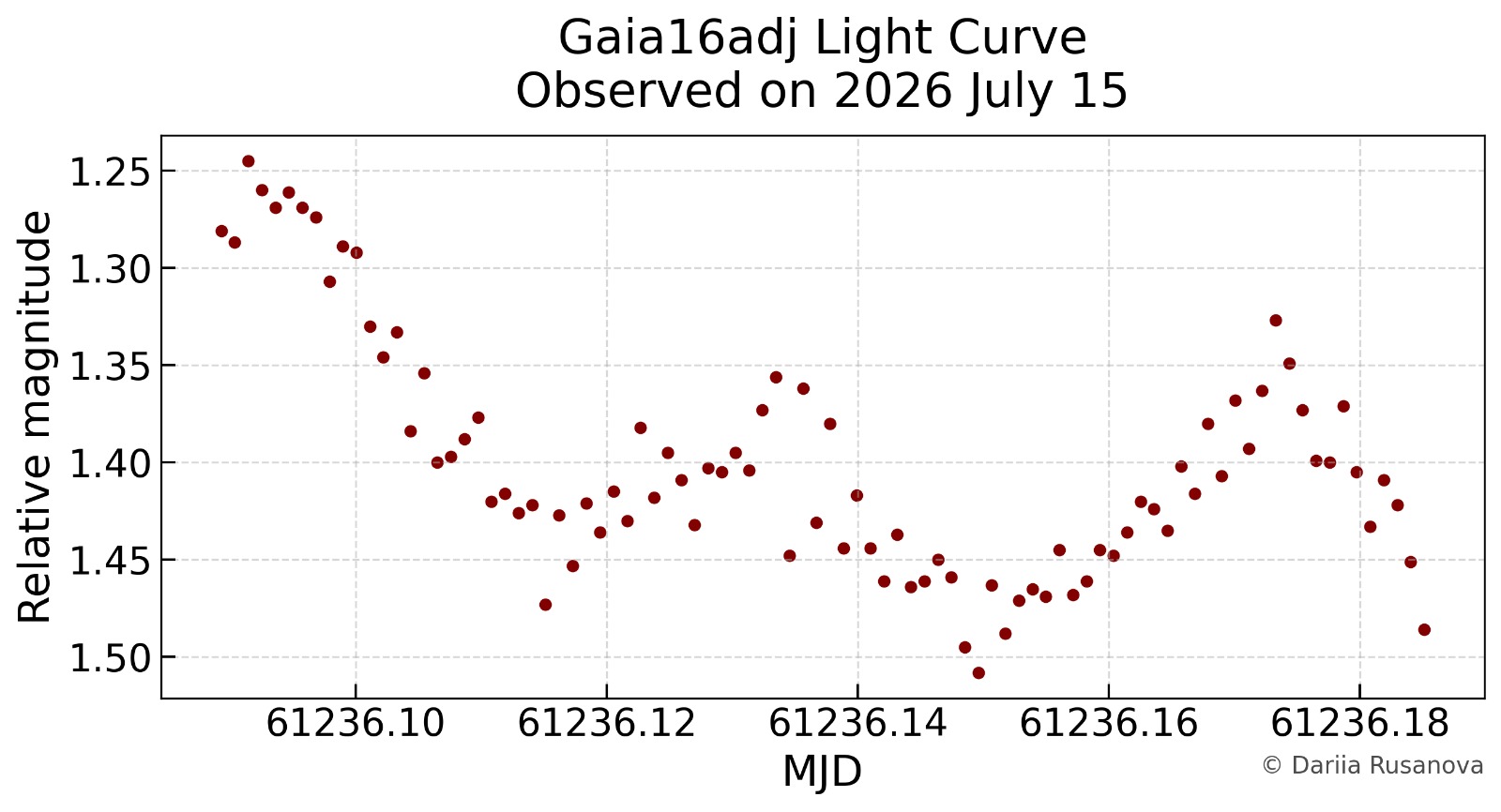
Additional time-series observations aimed to improve the superhump period determination were carried out on 2026 July 15 using a 0.4-m LCO telescope at the South African Astronomical Observatory (SAAO). These observations covered MJD 61236.0887632 - 61236.1856288, corresponding to approximately 2.3 hours.
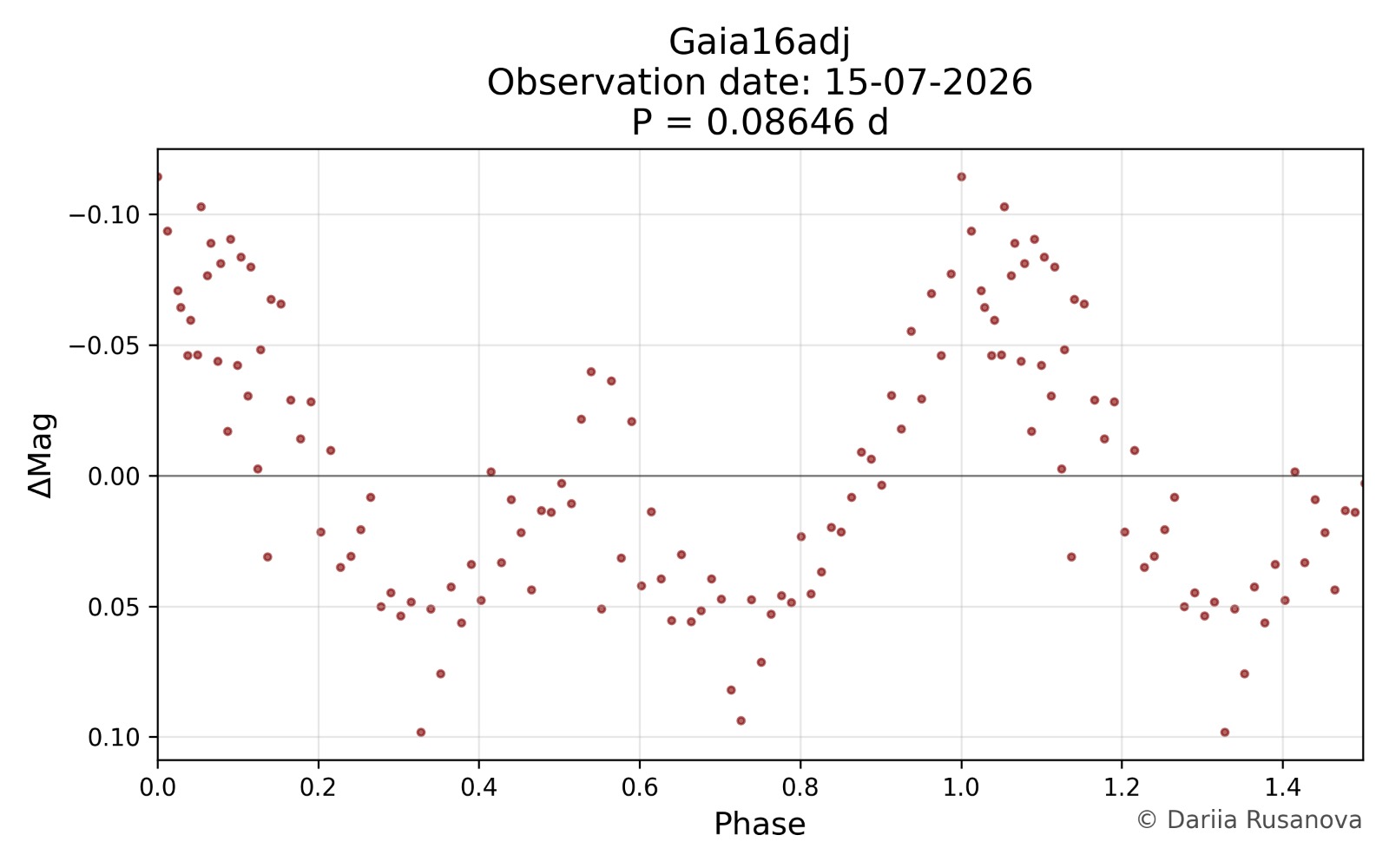
The resulting light curve (Fig. 1) clearly shows superhumps during the declining phase of the superoutburst. The dominant superhumps have a peak-to-peak amplitude of approximately 0.2 mag and a period of 0.086(4) d (Fig. 2). In addition, the light curve exhibits a well-defined secondary hump with an amplitude of approximately 0.09 - 0.10 mag, shifted by about 0.5 in phase relative to the primary superhumps. All materials can be found on A.O. Simon's personal website.
Our observations provide strong evidence that Gaia16adj/ASASSN-14eg is an SU UMa-type dwarf nova.
Further observations are strongly encouraged. Observers are invited to upload their observations to the object's BHTOM page, where all submitted data are automatically processed.
BHTOM is based on the open-source TOM Toolkit by LCO and has been developed with funding from the OPTICON-RadioNet Pilot (ORP) of the European Union's Horizon 2020 research and innovation programme under grant agreement No 101004719 (2021-2025). This project has received funding from the European Union's Horizon Europe Research and Innovation programme ACME under grant agreement No 101131928 (2024-2028).
Correction to ATel#17889: correct link for Fig.2 is here. All materials can be found on A.O. Simon's personal website.