Detection of superhumps during the superoutburst of Gaia19ati/ASASSN-15pa
ATel #17889; A. O. Simon (ASPD TShNU of Kyiv), J. Hambsch (VVS, GEOS, BAV), D. Yu. Rusanova (ASPD TShNU of Kyiv), P. J. Mikolajczyk (U. Wroclaw/NCBJ, PL), L. Wyrzykowski (U. Warsaw/NCBJ, PL/EASST. eu), K. Kotysz (U. Wroclaw/U. Warsaw, PL)
on 13 Jul 2026; 17:01 UT
Credential Certification: Andrew Simon (skazhenijandrew@gmail.com)
Subjects: Optical, Request for Observations, Cataclysmic Variable, Transient, Variables
Referred to by ATel #: 17905
We report the results of photometric observations of Gaia19ati/ASASSN-15pa carried out on 2026 July 11 with the 40-cm f/6.8 ODK telescope at Franz-Josef Hambsch's Remote Observatory Atacama Desert (ROAD) in Chile.
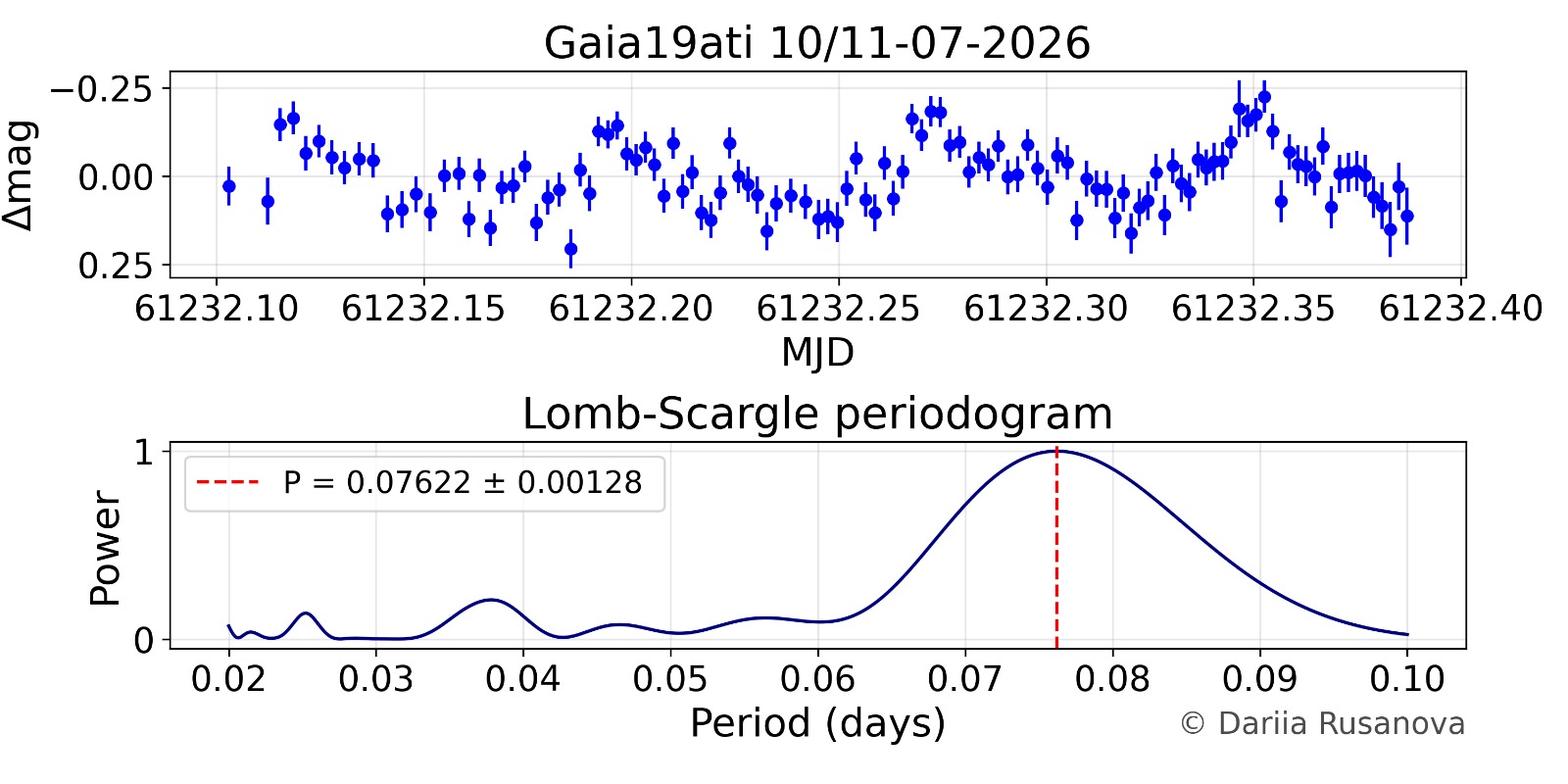
While inspecting the BHTom photometric data of Gaia19ati, we identified evidence of a possible superoutburst. The BHTom light curve clearly shows two types of outbursts: short (2 - 4 days) and long (14 - 15 days). The long outbursts are typically 0.5 - 0.6 mag brighter than the short ones. The most recent data points correspond to a higher-amplitude outburst that began about five days before our observations, suggesting that it is a long outburst. All these features are typical for superoutbursts of SU UMa type DN. We therefore began follow-up observations of the target as soon as it was possible in order to detect superhumps in the light curve. The observations covered MJD 61232.10263889 - 61232.38946759 corresponding to approximately 6.9 hours. The resulting light curve (Fig.1) clearly shows superhumps with a period of 0.076(1) d (Fig. 2) and a peak-to-peak amplitude of about 0.3 mag, estimated using the Lomb-Scargle periodogram implemented in SciPy (scipy.signal.lombscargle). According to the BHTom light curve, the outburst amplitude is about 3.7 mag. Based on the outburst amplitude, the detected periodic variations with a period of 0.076(1) d and the characteristic variability amplitude of 0.3 mag, we conclude that Gaia19ati is currently undergoing a superoutburst, strongly supporting its classification as an SU UMa-type dwarf nova.
Further observations are strongly encouraged. Observers are invited to upload their data to the object's BHTOM page, where all submitted observations are automatically processed. https://bhtom.space/public/targets/Gaia19ati
BHTOM is based on the open-source TOM Toolkit by LCO and has been developed with funding from the OPTICON-RadioNet Pilot (ORP) of the European Union's Horizon 2020 research and innovation programme under grant agreement No 101004719 (2021-2025). This project has received funding from the European Union's Horizon Europe Research and Innovation programme ACME under grant agreement No 101131928 (2024-2028).