Spectroscopic and photometric classification of ASASSN-17lp as a WZ Sge-type dwarf nova candidate
ATel #18149; Keisuke Isogai, Hiromasa Hoke (Kyoto University), Yusuke Tampo (South African Astronomical Observatory, University of Cape Town), Prabhakaran Andiappan (Jovian Observatory), Sahil Purabiya (M. G. Science Institute), Tonny Vanmunster (CBA Belgium Observatory, CBA Extremadura Observatory)
on 10 Nov 2026; 19:41 UT
Credential Certification: Keisuke Isogai (isogai@kusastro.kyoto-u.ac.jp)
Subjects: Optical, Cataclysmic Variable, Transient, Variables
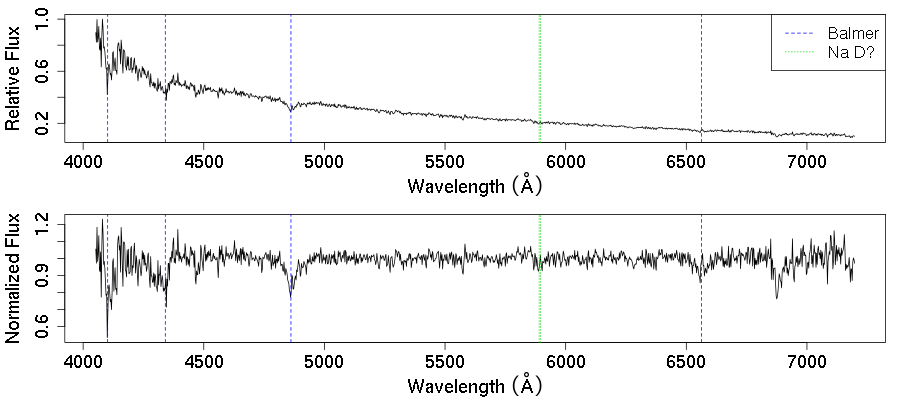
We report on spectral features seen in the transient ASASSN-17lp = ZTF18adgexkg = MASTER OT J072024.11+274152.5 on 2026-11-10.706 UT obtained by using a fiber-fed integral field spectrograph (KOOLS-IFU; Matsubayashi et al. 2019, 2025) attached to one of the Nasmyth focuses of the 3.8-m telescope Seimei at Okayama Observatory of Kyoto University. In short, we conclude that this object is a WZ Sge-type dwarf nova.
A new outburst of ASASSN-17lp was independently detected by Tadashi Kojima (VSOLJ), ZTF, and ATLAS.
The object reached g = 14.4 mag on 2026-11-05.41 UT.
The quiescent counterpart is g = 20.79(4) mag in Pan-STARRS1 (PS1),
indicating an outburst amplitude of ~6.4 mag.
Previous outbursts were detected in 2003 by the NEAT project and in 2017 by ASAS-SN (vsnet-alert 21396, 21391).
We obtained an optical spectrum on 2026-11-10.706 UT using KOOLS-IFU. The spectrum shows a blue continuum with Balmer and Na I absorption lines. The Hα absorption profile also exhibits a central emission core. These spectral features are consistent with a dwarf nova in outburst. We also obtained time-series photometry spanning 0.28 d and detected clear single-peaked superhumps. We estimated a preliminary superhump period of 0.0645 d, although aliasing remains possible.
Based on the large outburst amplitude, long outburst intervals, spectral features, and superhump period, we suggest that ASASSN-17lp is a WZ Sge-type dwarf nova. Further time-series photometric observations are encouraged to refine the superhump period and track the evolution of the superhump stages.
Our spectrum