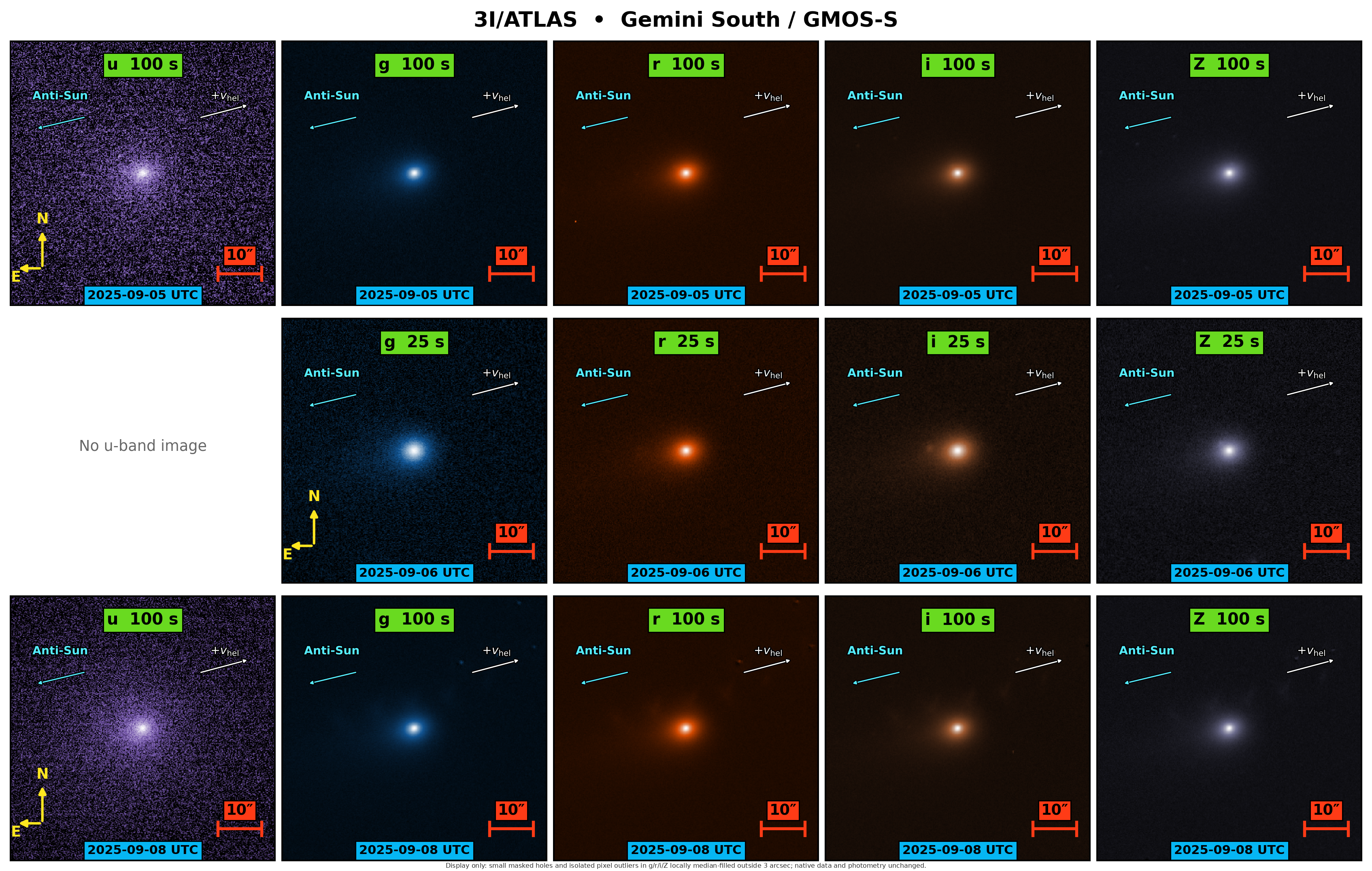
Coma and tail morphology of 3I/ATLAS from 2025 September Gemini South/GMOS multiband imaging
ATel #18128; Bryce T. Bolin (Eureka Scientific), Ian Wong (STScI), Brian Lemaux (Gemini Observatory), Laura-May Abron (Griffith Observatory), Pablo Candia (Gemini Observatory), Kristin Chiboucas (Gemini Observatory), Rodrigo Carrasco (Gemini Observatory), Verónica Firpo (Gemini Observatory), Christoffer Fremling (Caltech), Josef Hanuš (Charles University), Jeong-Eun Heo (Gemini Observatory), Piera King (Gemini Observatory), Keith Noll (Planetary Science Institute), Karleyne Silva (Gemini Observatory)
on 29 Oct 2026; 21:11 UT
Credential Certification: Bryce Bolin (bolin.astro@gmail.com)
Subjects: Optical, Comet, Solar System Object
The comet-aligned images show an extended coma and antisolar tail, continuing the morphology reported for August 27-28 in ATel #17363. We observed interstellar comet 3I/ATLAS (Bolin et al. 2025, MNRAS, 542, L139) on 2025 September 5, 6, and 8 UTC with the Gemini Multi-Object Spectrograph (GMOS) on the Gemini South 8.1-m telescope at Cerro Pachon (I11; GS-2025B-DD-102; PI Bryce T. Bolin). Imaging covered u, g, r, i, and Z on September 5 and 8, with 100 s per filter, and g, r, i, and Z on September 6, with 25 s per filter. Heliocentric distance decreased from 2.367 to 2.280 au; geocentric distance remained near 2.56 au. Panels have north up and east left. Cyan Anti-Sun and white +v_hel arrows show projected anti-solar and positive heliocentric velocity directions; lengths are illustrative.
For September 5, 6, and 8, respectively, approximate SDSS AB magnitudes are g = 16.15 +/- 0.06, 16.10 +/- 0.11, 15.96 +/- 0.06; r = 15.37 +/- 0.11, 15.31 +/- 0.10, 15.20 +/- 0.09; i = 15.13 +/- 0.04, 15.01 +/- 0.12, 14.97 +/- 0.04; and z = 15.01 +/- 0.04, 14.96 +/- 0.08, 14.86 +/- 0.05 mag (z denotes transformed GMOS Z photometry). September 8 gives a background-sensitive estimate u = 16.69 +/- 0.17 mag.
September 5 gives approximate SDSS u = 17.05 and u-g = 0.91 +/- 0.08 mag; September 8 gives u-g = 0.74 +/- 0.18 mag. The September 5 estimates assume stable transparency during the seven-hour standard-star transfer. Quoted errors exclude unquantified calibration and contamination systematics.
For September 5, 6, and 8, respectively, provisional colors are g-r = 0.78 +/- 0.13, 0.79 +/- 0.15, 0.75 +/- 0.11; r-i = 0.24 +/- 0.12, 0.30 +/- 0.15, 0.23 +/- 0.10; and i-z = 0.13 +/- 0.06, 0.05 +/- 0.14, 0.11 +/- 0.07 mag. Calibration uncertainties prevent a claim of significant color evolution.
Applying the Halley-Marcus dust phase correction to r gives provisional A(0)f(rho) estimates of 835 +/- 87, 859 +/- 79, and 897 +/- 76 cm on September 5, 6, and 8, respectively. Photometry uses unsmoothed images and 10,000-km-radius apertures (5.38-5.40 arcsec). Stellar-reference calibration follows the GMOS photometric methods used for 2024 YR4 (Bolin et al. 2025, ApJL, 984, L25), 2024 PT5 (Bolin et al. 2025, ApJL, 978, L37), and Neptunian Trojans (Bolin et al. 2023, MNRAS, 521, L29).
Based on observations obtained at the international Gemini Observatory, a program of NSF's NOIRLab, which is managed by the Association of Universities for Research in Astronomy (AURA) under a cooperative agreement with the U.S. National Science Foundation on behalf of the Gemini Observatory partnership: the U.S. National Science Foundation (United States), National Research Council (Canada), Agencia Nacional de Investigacion y Desarrollo (Chile), Ministerio de Ciencia, Tecnologia e Innovacion (Argentina), Ministerio da Ciencia, Tecnologia e Inovacoes (Brazil), and Korea Astronomy and Space Science Institute (Republic of Korea).
2025 September 5, 6, and 8 UT Gemini/GMOS images of 3I/ATLAS