Four-band near-infrared imaging of 3I/ATLAS: Keck/MOSFIRE observations on 2025 July 11
ATel #18126; Bryce T. Bolin (Eureka Scientific), Leo Y. Alcorn (W. M. Keck Observatory), Matt Wahl (W. M. Keck Observatory), Laura-May Abron (Griffith Observatory), Jameeka Marshall (University of California, Santa Cruz)
on 29 Oct 2026; 09:57 UT
Credential Certification: Bryce Bolin (bolin.astro@gmail.com)
Subjects: Infra-Red, Comet, Solar System Object
We obtained Y, J, H, and Ks observations of interstellar comet 3I/ATLAS (Bolin et al. 2025, MNRAS, 542, L139) with MOSFIRE on Keck I on 2025 July 11 UTC, through engineering program 2025A E498 (PI: Josh Walawender). The inbound comet was at heliocentric and geocentric distances of 4.17 and 3.22 au, with a phase angle of approximately 5.5 degrees.
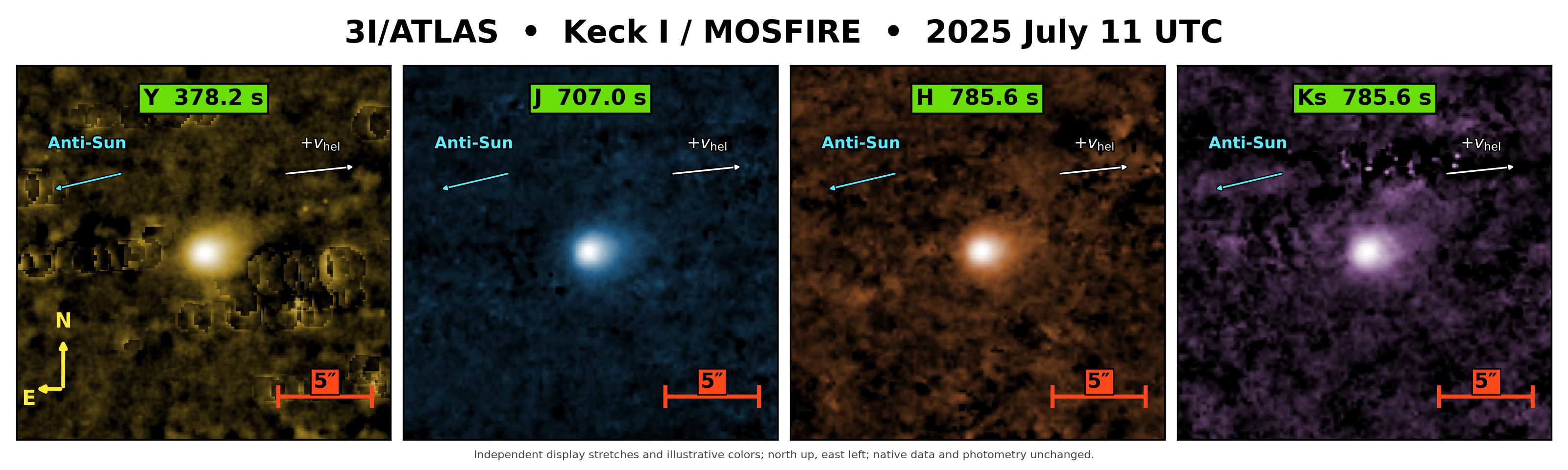
The Y, J, H, and Ks images show a centrally concentrated coma. Panels span 20 arcsec, with north up, east left, 5-arcsec bars, illustrative colors, and independent stretches. Cyan Anti-Sun and white +v_hel arrows show the projected anti-solar and positive heliocentric velocity directions at each filter's epoch; lengths are illustrative. The J-band core has a fitted minor-axis FWHM of 1.31 arcsec versus 0.58â0.61 arcsec for two field sources, supporting a resolved coma. Tracking and structured backgrounds limit this comparison; no point-source aperture correction was applied.
A 0.72-arcsec-radius aperture (approximately 1680 km) gives approximate native-system Vega magnitudes Y = 17.59 +/- 0.12, J = 17.12 +/- 0.02, H = 17.10 +/- 0.06, and Ks = 17.11 +/- 0.05. Errors describe local measurement sensitivity at fixed calibration. Separate calibration sensitivities are 0.25, 0.18, 0.25, and 0.29 mag in Y, J, H, and Ks; these are not validated Gaussian uncertainties. Y is the median of complete-aperture measurements in 13 individual exposures, not photometry of the displayed mean stack.
The aperture colors are Y-J = 0.46 +/- 0.13, J-H = 0.03 +/- 0.07, H-Ks = -0.01 +/- 0.09, and J-Ks = 0.01 +/- 0.08 mag. These errors include adopted local and aperture sensitivities, conditional on the stellar calibration.
The retained Y, J, H, and Ks data comprise 13, 27, 27, and 27 exposures totaling 378, 707, 786, and 786 s, respectively. Exposure-weighted midpoints were July 11 07:14, 07:09, 07:18, and 07:27 UTC.
Processing includes offset, flat-field, and sky corrections and removal of field sources while protecting the coma. Reduction and aperture photometry follow the methods for 2024 YR4 (Bolin et al. 2025, ApJL, 984, L25) and 2024 PT5 (Beniyama et al. 2025, A&A, 700, A183), adapted for the resolved coma. Calibration uses a reddened stellar-atmosphere model fitted to Pan-STARRS photometry of an A0-like reference star; three bridge stars transfer Y calibration from sidereally tracked images. The nominal blue J-H and J-Ks depend on this model. Calibration covariance is unquantified and images are not PSF matched; the measurements alone do not establish intrinsic color evolution or a compositional feature.
We thank the W. M. Keck Observatory staff and acknowledge the cultural role and reverence of Maunakea within the Indigenous Hawaiian community.
July 11 Keck/MOSFIRE Y, J, H, and Ks imaging