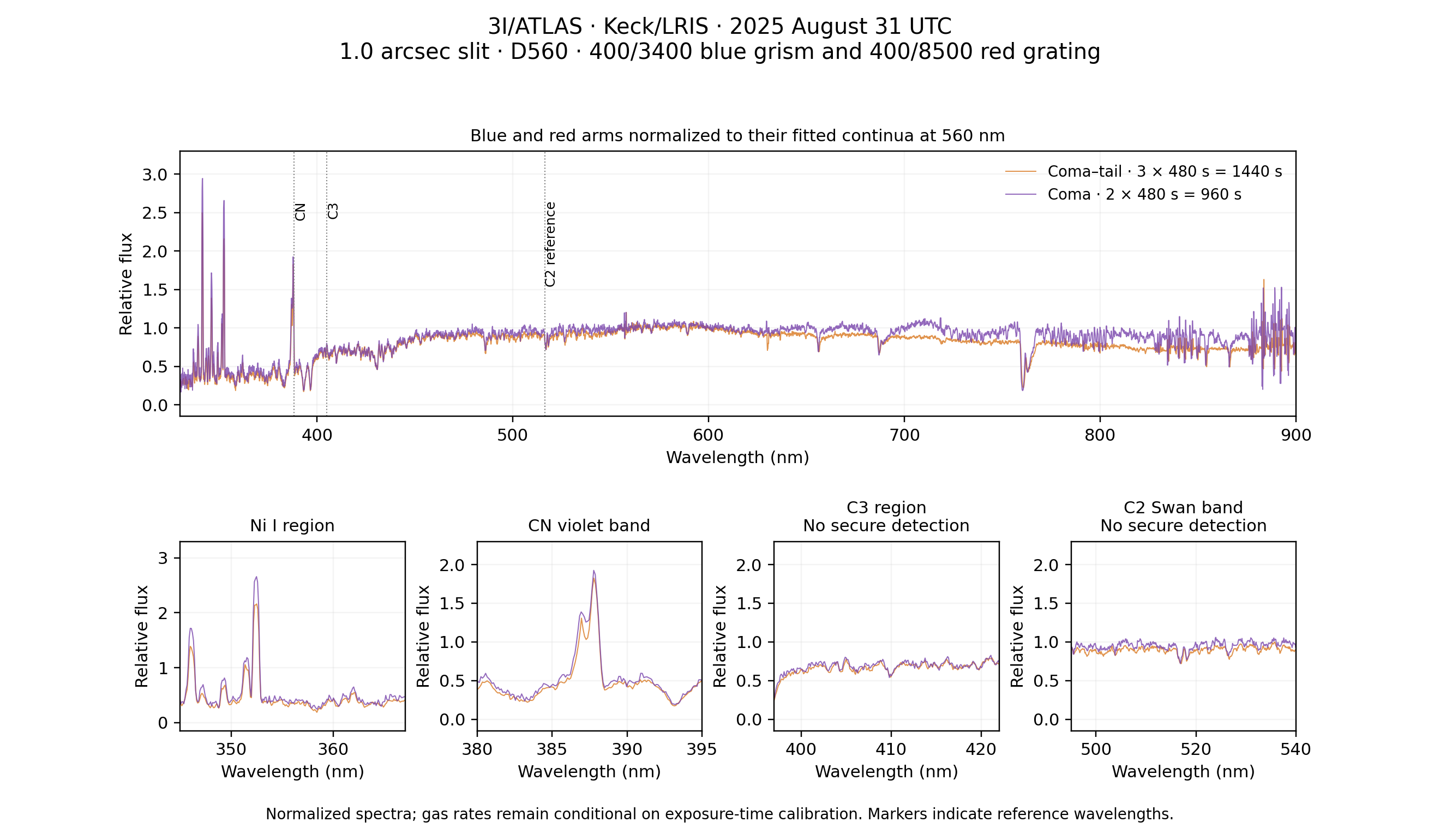
CN and Ni I emission in the 2025 August 31 Keck/LRIS spectra of 3I/ATLAS
ATel #18124; Bryce Bolin (Eureka Scientific), Jeffrey Cooke (Swinburne University of Technology and OzGrav), Ryan Ridden (University of Canterbury), Mark Suhr (Swinburne University of Technology)
on 29 Oct 2026; 06:52 UT
Credential Certification: Bryce Bolin (bolin.astro@gmail.com)
Subjects: Optical, Comet, Solar System Object
We detect CN and Ni I in spectra of interstellar comet 3I/ATLAS (Bolin et al. 2025, MNRAS, 542, L139) obtained with Keck I/LRIS on 2025 August 31 UTC (local night August 30; W353, PI Cooke). We used a 1.0-arcsec slit, 560-nm dichroic, 400/3400 grism, and 400/8500 grating at heliocentric/observer distances 2.537/2.578 au and phase angle 22.75 deg.
Six 480-s exposures span 06:08-06:55 UTC. Three retained coma-tail exposures total 1440 s; a fourth was rejected for possible stellar contamination. Two coma exposures at the parallactic angle total 960 s. G191B2B and HD150469 provide the flux response and solar comparison. Methods follow Bolin et al. (2021, AJ, 161, 116; 2024, MNRAS, 527, L42).
Both stacks carry EXPTIME=1200 s. Assuming this value calibrated summed counts, we multiply coma/coma-tail fluxes and uncertainties by 1.25/0.8333. All rates and bounds below depend on this unverified assumption and adopt a uniform 1.0 x 9.45 arcsec extraction, 0.5 km s-1 outflow, and 0.8-arcsec seeing. Stacks are analyzed separately; their combined product does not strengthen limits. Values below are ordered coma, coma-tail.
Q(CN)=(6.84 +/- 0.20) E24 and (5.50 +/- 0.17) E24 molecules s-1 from the 388-nm band, using an extraction-matched Haser model (Haser 1957, Bull. Acad. R. Belg. Cl. Sci., 43, 740), parent/daughter scales of 17,000/300,000 km at 1 au scaled as heliocentric distance squared, and epoch-dependent fluorescence (Schleicher 2010, AJ, 140, 973). The 1-sigma errors include spectral covariance and residual noise, but exclude absolute-calibration and extraction-transfer errors.
C2 is undetected near 517 nm. Full-sequence templates with continuum/registration controls and residual-adjusted positive-part-plus-3-sigma thresholds give upward-rounded model-envelope bounds Q(C2) < 1.82 E24 molecules s-1 for each stack, not complete confidence limits. Molecular scales and C2/C3 fluorescence follow Cochran et al. (2012, Icarus, 218, 144; see Cochran 1985, AJ, 90, 2609; Cochran et al. 1992, Icarus, 98, 151).
C3 band-equivalent indices are (4.62 +/- 2.18) E23 and (3.29 +/- 1.33) E23 s-1; alternative continua permit zero. Conditional estimator-envelope bounds are < 1.87 E24 and < 1.33 E24 s-1, assuming unit full-band estimator response and retained fluorescence normalization. These are diagnostic indices, not verified total production rates or detections.
Ni I is identified by the earlier joint 347-356/358-366 nm fit. Rescaling for logged integrations, aperture, and distances gives approximate Q(Ni I) ~2.12 E23 and ~1.61 E23 atoms s-1, retaining a short-source, long-lived 1/rho model, fixed fluorescence populations, and inverse-square solar scaling. Missing original covariance and velocity-dependent line efficiencies preclude an independent fluorescence refit. Orientation/calibration differences prevent spatial-abundance inference.
The spectra and Ni I, CN, C3, and C2 stamps use separate arm continua extrapolated to 560 nm for display alignment only. Unknown extraction weights, inherited extended-coma sky subtraction, slit losses, and absolute calibration remain systematic limitations. These observations precede ATel #17503.
Keck Observatory is operated by Caltech, UC, and NASA with support from the W. M. Keck Foundation. Public raw data are available through KOA, operated by Keck and NExScI under contract with NASA. We acknowledge Maunakea's profound cultural significance and reverence within the Native Hawaiian community and are grateful to observe from this mountain.
2025 August 31 Keck/LRIS spectra of 3I/ATLAS