Superhumps in Gaia19bnd: a newly identified SU UMa-type dwarf nova
ATel #18106; D. Yu. Rusanova (ASPD TShNU of Kyiv, Ukraine), A. O. Simon (ASPD TShNU of Kyiv, Ukraine), S. Dufoer (VVS, Belgium), F.-J. Hambsch (VVS, GEOS, BAV, Belgium), S. Kurowski (Jagiellonian University, PL/SOA Bolecina, Poland), S. Fisek (Istanbul University, Turkey), S. Otken (Istanbul University, Turkey), A. Popowicz (SUTO, Poland), A. Yu. Korosko (ASPD TShNU of Kyiv, Ukraine), P. J. Mikolajczyk (U. Wroclaw/NCBJ, Poland), L. Wyrzykowski (U. Warsaw/NCBJ, PL/EASST. eu, Poland), K. Kotysz (U. Wroclaw/U. Warsaw, Poland), W. Ogloza (UKEN, Cracow; Silesian Planetarium Chorzow, Poland), N. Karaman (Adiyaman Univ., Turkey), J. M. Carrasco (U. Barcelona, SP), D. Athanasopoulos (National Observatory of Athens, Greece), K. Vrontaki (National Observatory of Athens, Greece), E. Gkiokas (National Observatory of Athens, Greece), J. K.T. Qvam (Horten Videregaende Skole, Norway), R. A. Street (Las Cumbres Observatory, California, USA) , A. Pucek (Jagiellonian University, Poland), W. Skrobacz (U. Warsaw, Poland), J. Kolar (Masaryk University, Czechia)
on 16 Oct 2026; 09:34 UT
Credential Certification: Andrew Simon (skazhenijandrew@gmail.com)
Subjects: Optical, Request for Observations, Cataclysmic Variable, Transient, Variables
Based on its long-term light curve, we identified Gaia19bnd/AT 2019dyn as a candidate SU UMa-type dwarf nova. Its outburst activity is characterized by frequent short outbursts and longer, brighter events, likely superoutbursts, lasting approximately 11-13 days.
The next superoutburst of Gaia19bnd was predicted by our Outbursts Alerting System, prompting us to initiate intensive monitoring of the object. The observing campaign began on MJD 61275, and four normal outbursts were recorded by participating observers. On MJD 61323, the onset of a new outburst was detected at the Remote Observatory Atacama Desert (ROAD) in Chile.
Time-resolved photometric observations were obtained using the C14 f/7 telescope at Franz-Josef Hambsch's Remote Observatory Atacama Desert (ROAD) in Chile, the 0.4-m telescope of the EEye Astronomical Complex, the 0.7-m f/4 AZT-8 telescope at the Observational Station Lisnyky of Taras Shevchenko National University of Kyiv, the 0.5-m OAUJ Cassegrain Telescope, the IST40 telescope of the Istanbul Observatory and the SUTO-Otivar 30-cm Telescope.
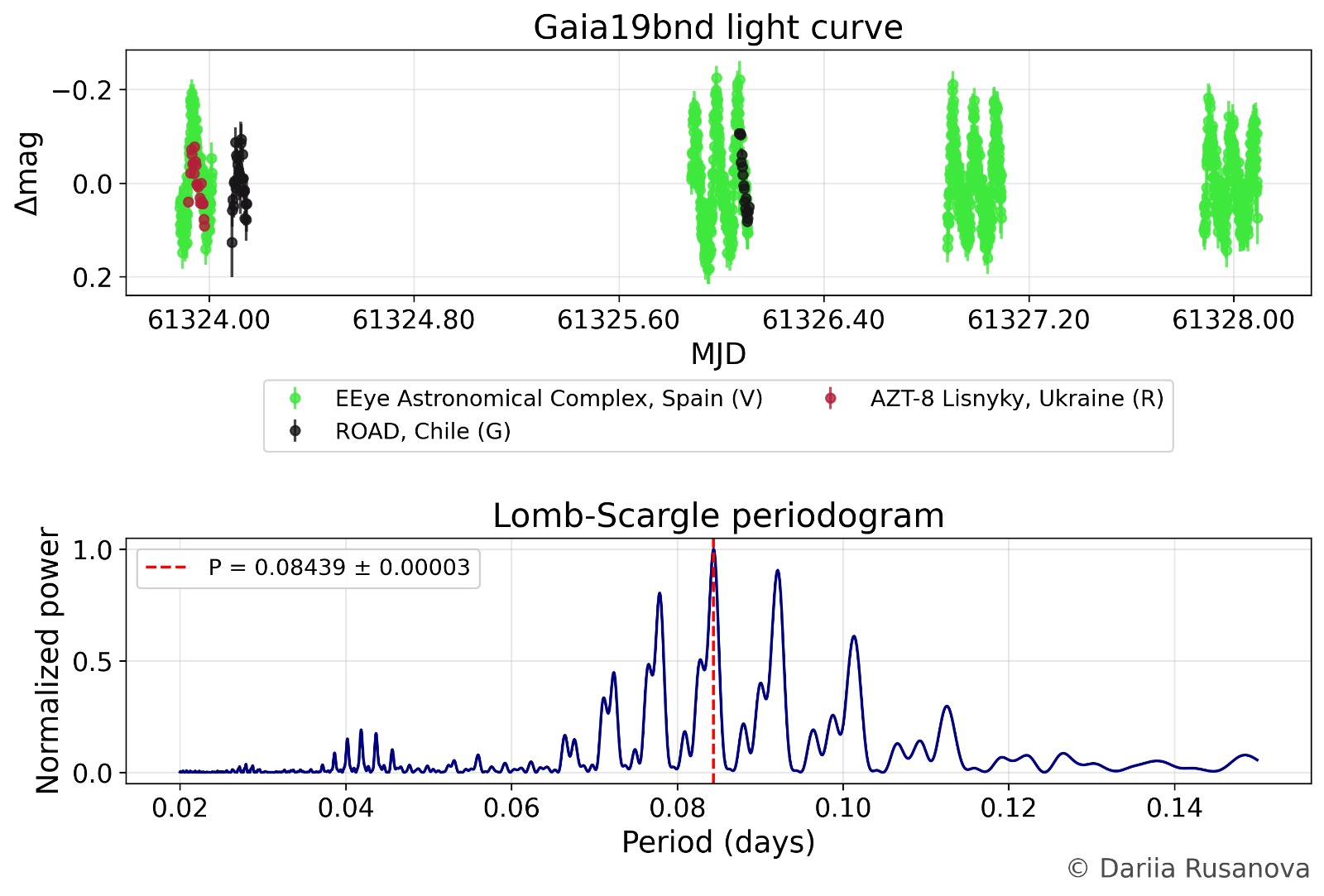
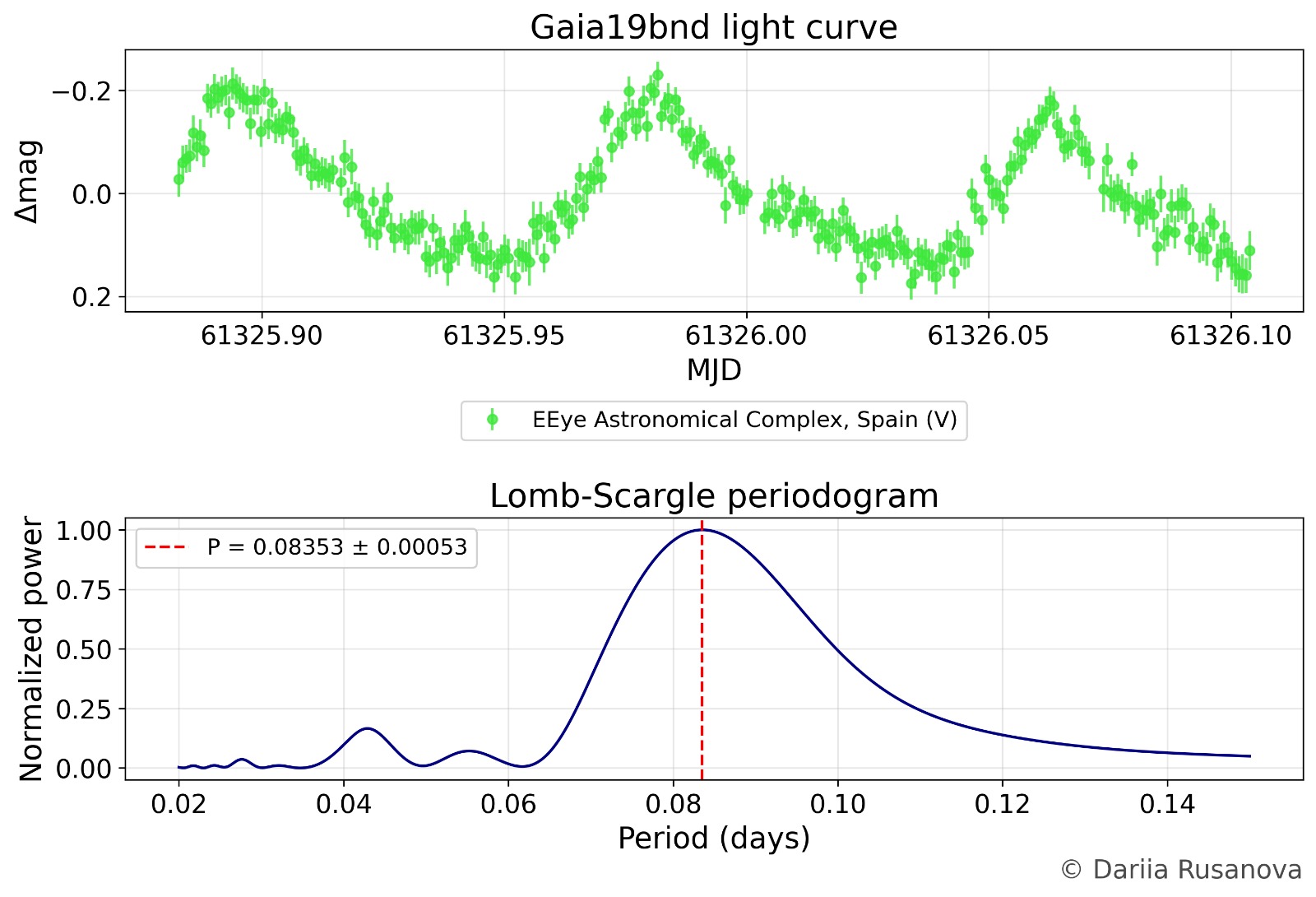
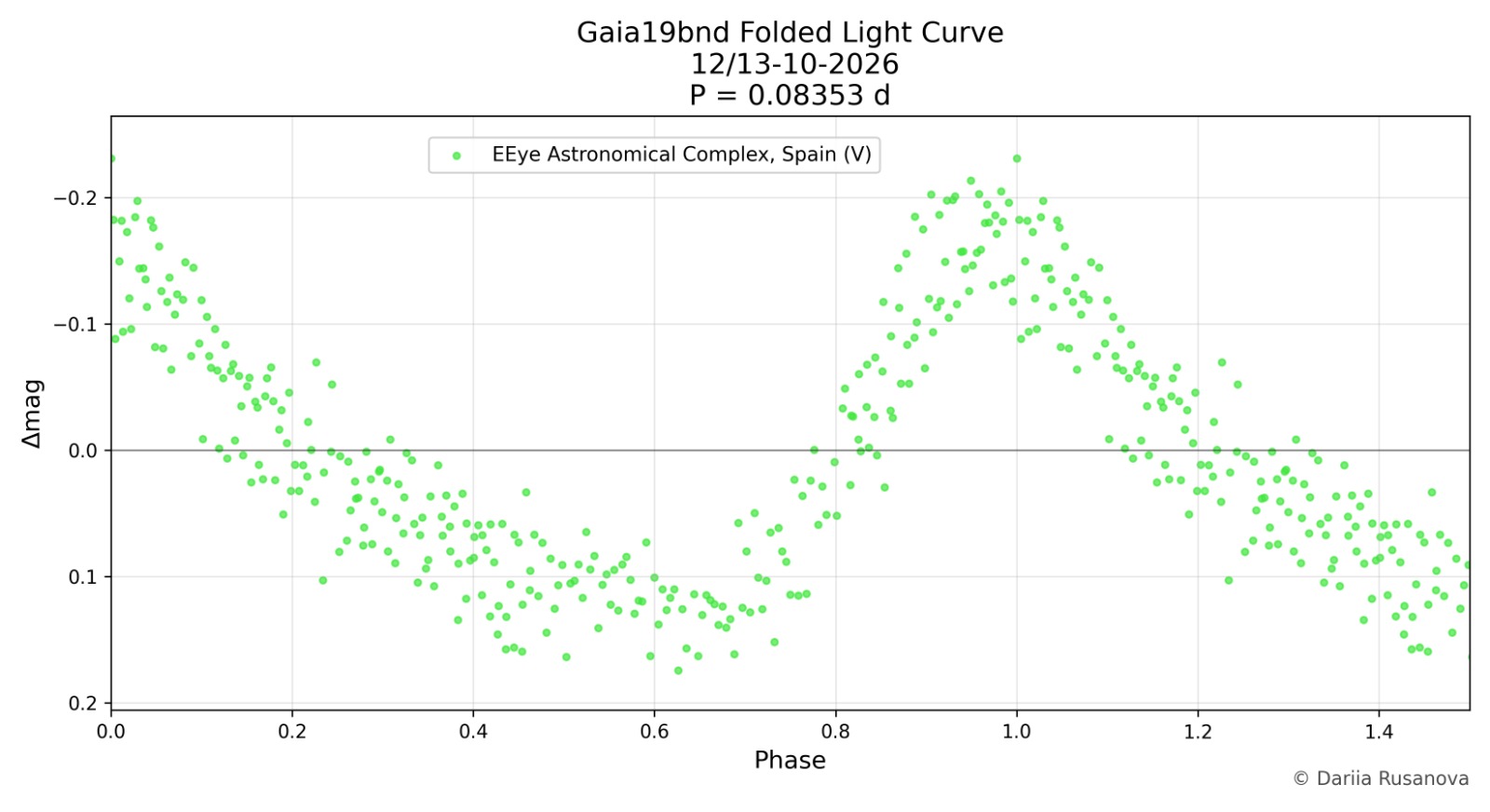
Observations obtained on MJD 61323-61328 reveal prominent periodic brightness modulations characteristic of superhumps. A Lomb-Scargle analysis of the combined observations yields a dominant period of 0.08439(3)d (Fig.1). An analysis of the continuous EEye observations on MJD 61325-61328 yields a period of 0.08353(53)d (Fig.2). The phase-folded light curve shows pronounced asymmetric modulations with a peak-to-peak amplitude of approximately 0.3 mag (Fig.3).
The detection of superhumps, together with the presence of normal outbursts and longer, brighter outbursts, supports the classification of Gaia19bnd as an SU UMa-type dwarf nova and the identification of the current event as a superoutburst.
Further observations are strongly encouraged. Observers are invited to upload their observations to the object's BHTOM page, where all submitted data are automatically processed: https://bhtom.space/public/targets/Gaia19bnd.
BHTOM is based on the open-source TOM Toolkit by LCO and has been developed with funding from the OPTICON-RadioNet Pilot (ORP) of the European Union's Horizon 2020 research and innovation programme under grant agreement No 101004719 (2021-2025). This project has received funding from the European Union's Horizon Europe Research and Innovation programme ACME under grant agreement No 101131928 (2024-2028).