SU Lyn, the prototype of LowAcc symbiotic stars, is undergoing a major surge in accretion
ATel #18083; U. Munari (INAF Padova), P. Valisa, G. L. Righetti, and S. Dallaporta (ANS Collaboration)
on 1 Oct 2026; 10:25 UT
Credential Certification: U. Munari (ulisse.munari@oapd.inaf.it)
Subjects: Optical, Cataclysmic Variable, Nova
The S6,1 red giant SU Lyn was discovered by Mukai et al. (2016, MNRAS
461, L1) to be the counterpart of the unidentified hard X-ray source 4PBC
J0642.9+5528 detected during the Swift Burst Alert Telescope (BAT) survey.
In showing a large ultraviolet excess and feeble optical emission lines -
which are properly observable only in high resolution Echelle spectra - it
became the prototype (Munari et al. 2021, MNRAS 505, 6121) of low accretion
(LowAcc) symbiotic stars (Lacc < 10 Lsun). Simple evolutionary arguments
indicate that symbiotic stars (SySts) spend most of their intra-burning
lifes in LowAcc phases (Munari 2019, arXiv1909-01389), and therefore systems in
this state dominate the SySt population counts throughout the Galaxy.
Our continued photometric and spectroscopic monitoring of SU Lyn over
the past 10 yrs shows that when it was identified by Mukai et al. in
2015-2016 the star was going through a much higher level of accretion (about
10 Solar luminosities) than displayed ever since (radiating as low as 0.5
Solar luminosities during 2019-2023; Munari et al. 2026, A&A accepted in
press). When at the beginning of September 2026, after emergence from
Solar conjunction, we resumed our monitoring of SU Lyn we unexpectedly found
it to have returned to - and even surpassed - the accretion luminosity
experienced in 2015-2016. This is a clean confirmation of the fact that the
accretion levels in SySts are highly variable over long-time scales
(Luna et al. 2020, ApJ 902, L14).
Echelle spectra of SU Lyn have been obtained with the Varese 0.84m
telescope on 2026 Sept 12.151 and 28.135 UT at 16,000 resolving power and
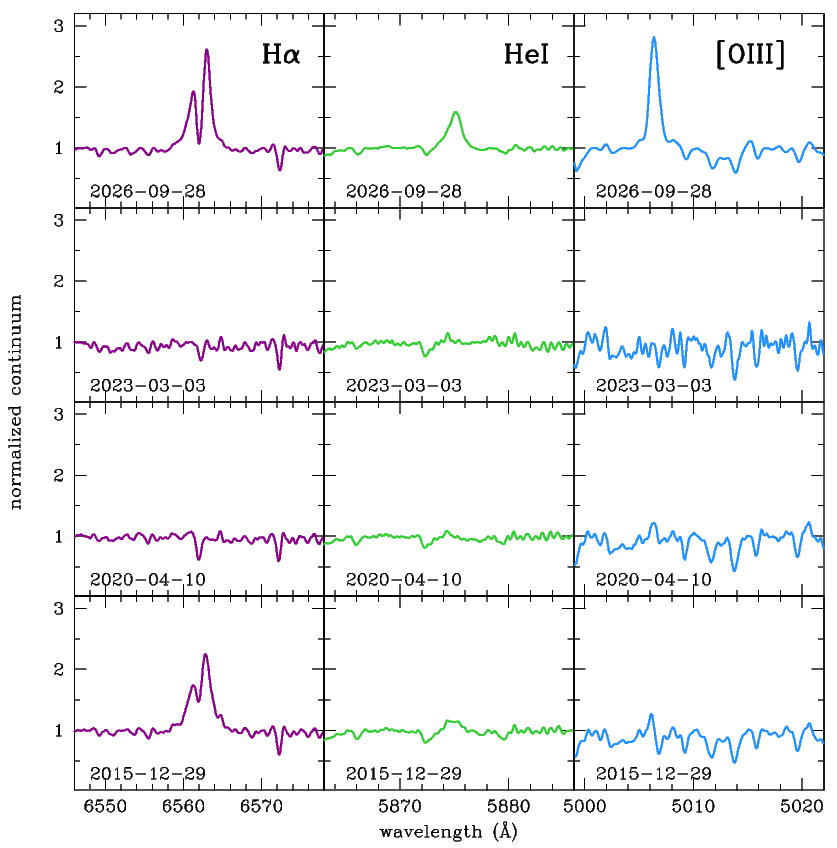
4000-9310 Ang range. They show an Halpha emission vastly more intense than
in the 2019-2023 period and somewhat even stronger than in 2015-2016.
Similarly, [OIII] 4363, 4959, 5007 lines which were absent in 2015-2016 are
now prominent in emission, as are HeI lines (very weak in 2015-2016
and completely absent in 2019-2023). This
figure compares Halpha, [OIII], and HeI 5876 in 2015, 2020, 2023, and 2026.
The current surge in accretion started during the recent Solar conjunction,
because on our latest Asiago 1.82m Echelle spectrum from 2026 May 15, the
appearance of SU Lyn was the usual one, with no detectable emission other
than weak Hbeta and Halpha lines.
We have been maintaining a tight photometric monitoring of SU Lyn since
its 2015 discovery primarily via ANS Collaboration telescopes ID 0310, 1507,
and 1512. Our latest two sets of UBV data are:
     UT             U               B              V
2026-09-28.974   10.339 +-0.010  10.325 +-0.011  8.529 +-0.009
2026-09-29.968   10.473 +-0.030  10.407 +-0.012  8.519 +-0.012
The U-B color currently close to 0.0 and much bluer than the +1.2 value
of deep quiescence, clearly indicates the presence of a large excess in the
near-UV emission driven by the presently enhanced accretion status.
We will keep monitoring SU Lyn, and observations at other wavelengths are
encouraged.