A new superoutburst of the period-gap SU UMa-type dwarf nova Gaia22cax
ATel #18068; D. Yu. Rusanova (ASPD TShNU of Kyiv, Ukraine), S. Dufoer (VVS, Belgium), A. O. Simon (ASPD TShNU of Kyiv, Ukraine), A. Yu. Korosko (ASPD TShNU of Kyiv, Ukraine), J. K.T. Qvam (Horten Videregaende Skole, Norway), S. Kurowski (Jagiellonian University, PL/SOA Bolecina, Poland), F.-J. Hambsch (VVS, GEOS, BAV, Belgium), W. Ogloza (UKEN, Cracow; Silesian Planetarium Chorzow, Poland), N. Karaman (Adiyaman Univ., Turkey), M. Dominik (St. Andrews University, Scotland, UK), P. J. Mikolajczyk (U. Wroclaw/NCBJ, Poland), L. Wyrzykowski (U. Warsaw/NCBJ, PL/EASST. eu, Poland), K. Kotysz (U. Wroclaw/U. Warsaw, Poland)
on 21 Sep 2026; 23:02 UT
Credential Certification: Andrew Simon (skazhenijandrew@gmail.com)
Subjects: Optical, Request for Observations, Cataclysmic Variable, Transient, Variables
Gaia22cax/CSS101127:000130+050624/AT 2020qvd is an SU UMa-type dwarf nova located in the period gap. Kato et al. (2017; doi: 10.1093/pasj/psx058) reported a superhump period of 0.09477(1)d during its 2016 superoutburst.
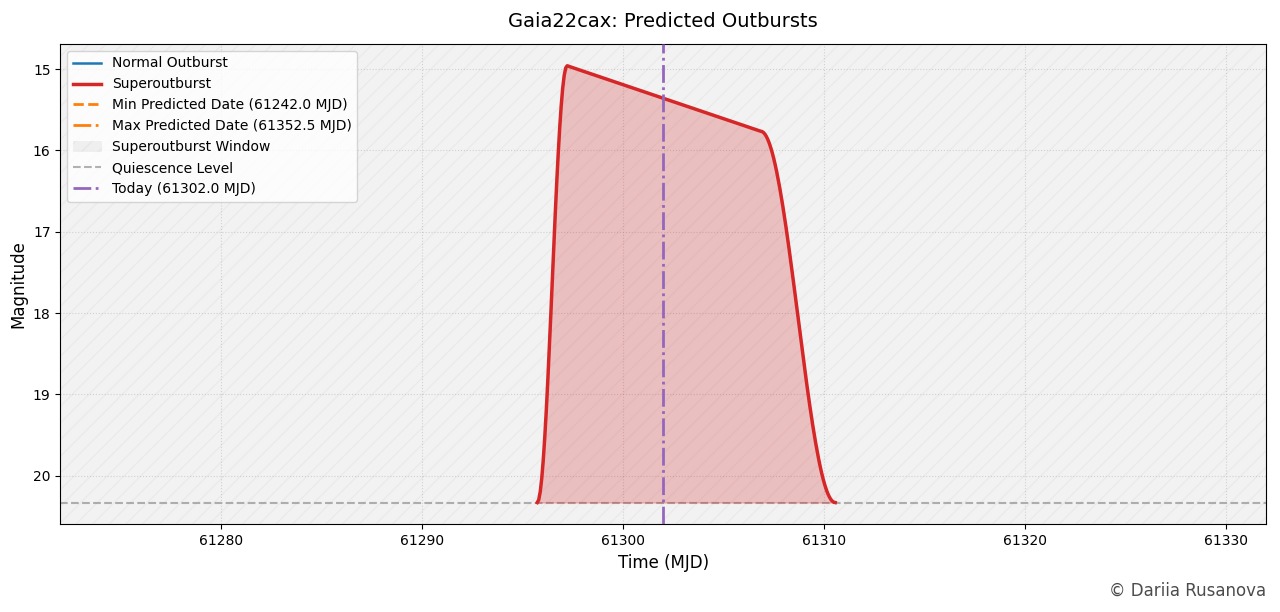
Using our Outbursts Alerting System, we predicted the next superoutburst to occur within MJD 61242-61352, with the highest probability of occurrence during MJD 61280-61310. We therefore initiated monitoring of the object with the LCO network at a cadence of approximately two days.
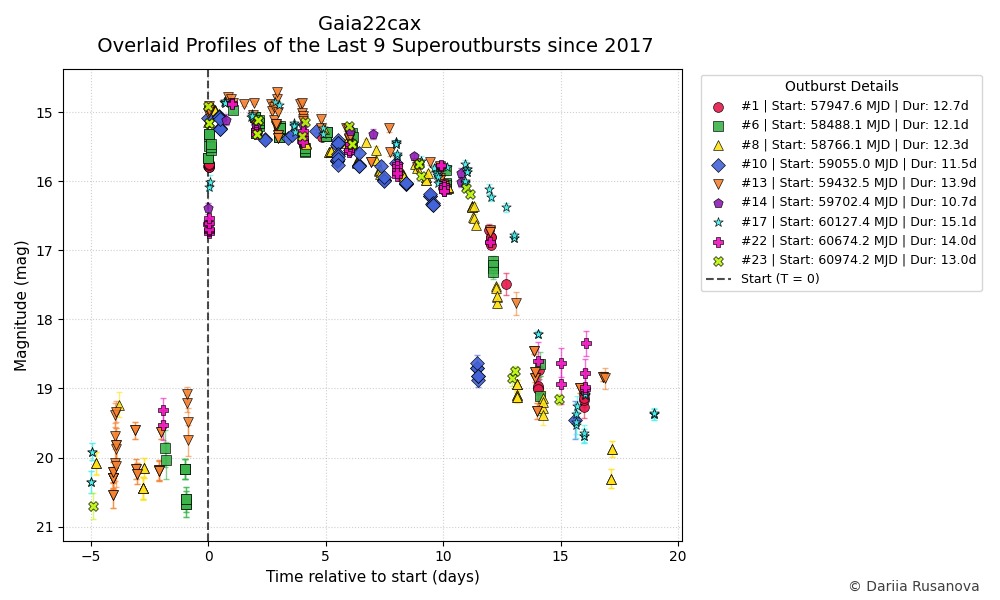
According to observations obtained with the LCO 1-m telescope at Teide Observatory, the new outburst began around MJD 61302. This onset is in excellent agreement with the predicted date based on the mean supercycle length (Fig. 1). Previous superoutbursts typically lasted approximately 11-15 days (Fig. 2), which prompted us to initiate a follow-up campaign immediately.
Following the detection of the outburst onset, we initiated an intensive observing campaign within the BHTOM collaboration using five facilities: the 0.41-m telescope at the School Astronomical Observatory Bolecina, the 0.4-m telescope of the EEye Astronomical Complex, the C14 f/7 telescope at Franz-Josef Hambsch's Remote Observatory Atacama Desert (ROAD) in Chile, the 0.6-m f/6.5 ADYU60 reflector at the Observatory of Adiyaman University, and the 0.68-m telescope at Horten Local Observatory. Materials related to this observing campaign are available on A.O. Simon's personal website.
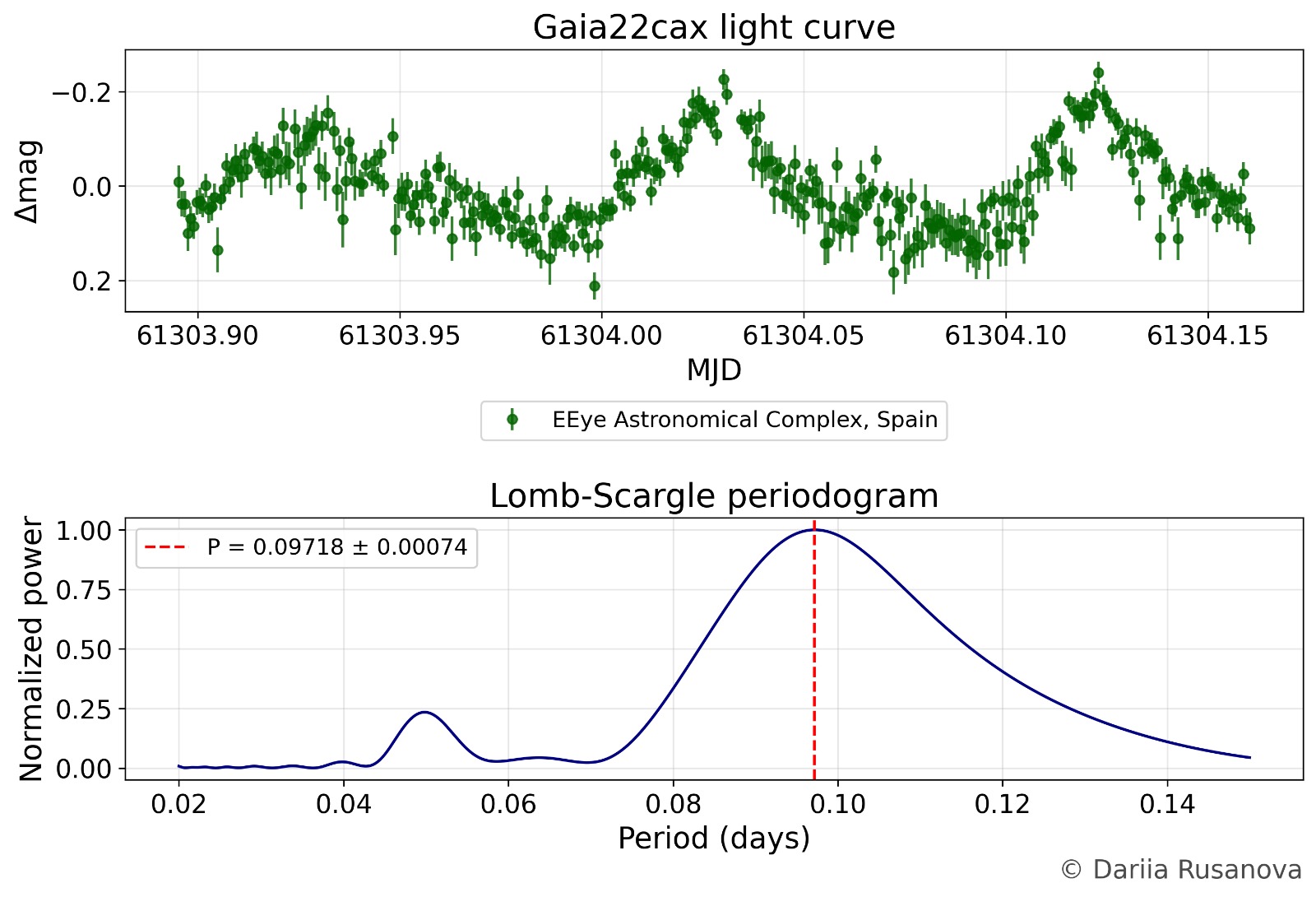
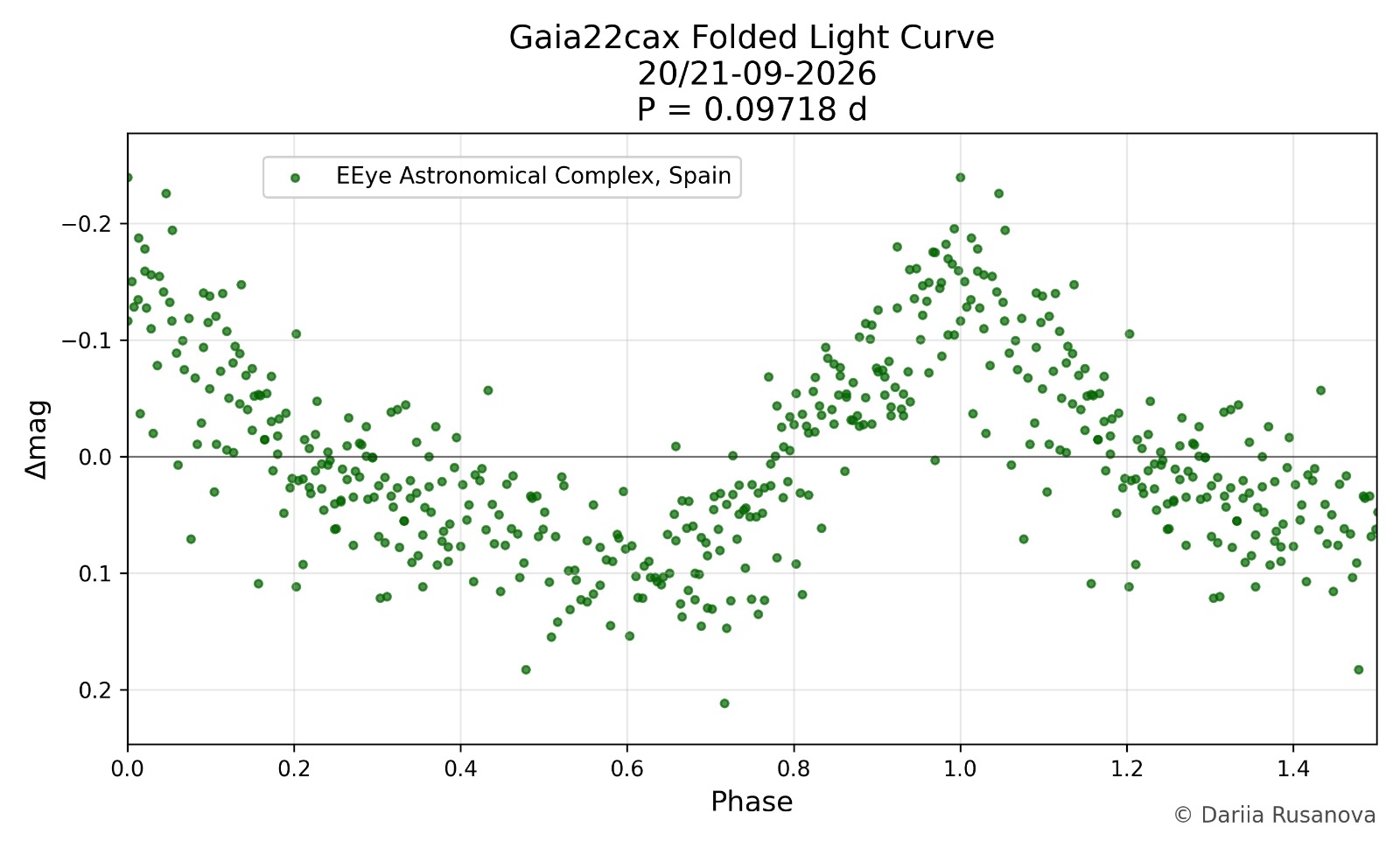
On MJD 61303, the light curve showed brightness variations with a peak-to-peak amplitude of approximately 0.1m. On MJD 61304, clear superhump modulations were detected, with a period of 0.09718d (Fig. 3) and a peak-to-peak amplitude of approximately 0.3m (Fig. 4). These values are in excellent agreement with those reported during the early stage of the 2016 superoutburst in VSNET-ALERT 20152, where a superhump period of 0.0970(7)d and an amplitude of 0.31m were measured.
During the later stage of the 2016 superoutburst, the superhump period decreased to 0.09499(6)d, possibly corresponding to stage C superhumps (VSNET-ALERT 20176). Continued time-resolved photometry is therefore strongly encouraged to follow the superhump evolution during the current superoutburst.
Further observations are strongly encouraged. Observers are invited to upload their observations to the object's BHTOM page, where all submitted data are automatically processed: https://bhtom.space/public/targets/Gaia22cax.
BHTOM is based on the open-source TOM Toolkit by LCO and has been developed with funding from the OPTICON-RadioNet Pilot (ORP) of the European Union's Horizon 2020 research and innovation programme under grant agreement No 101004719 (2021-2025). This project has received funding from the European Union's Horizon Europe Research and Innovation programme ACME under grant agreement No 101131928 (2024-2028).