Gaia20cnt: photometric observations of a new outburst
ATel #18059; D. Yu. Rusanova (ASPD TShNU of Kyiv, Ukraine), A. O. Simon (ASPD TShNU of Kyiv, Ukraine), A. Yu. Korosko (ASPD TShNU of Kyiv, Ukraine), P. J. Mikolajczyk (U. Wroclaw/NCBJ, Poland), L. Wyrzykowski (U. Warsaw/NCBJ, PL/EASST. eu, Poland), K. Kotysz (U. Wroclaw/U. Warsaw, Poland), V. V. Vasylenko (ASPD TShNU of Kyiv, Ukraine)
on 19 Sep 2026; 07:45 UT
Distributed as an Instant Email Notice Transients
Credential Certification: Andrew Simon (skazhenijandrew@gmail.com)
Subjects: Optical, Request for Observations, Cataclysmic Variable, Star, Transient, Variables
The beginning of a new outburst of Gaia20cnt/ASASSN-14fc/AT 2020loj was detected during our monitoring of the object with a Unistellar eVscope (provided by Mike Simmons through the Astronomy for Equity program). Following the detection, we initiated time-resolved photometric observations with the 0.7-m f/4 AZT-8 telescope at the Observational Station Lisnyky of Taras Shevchenko National University of Kyiv.
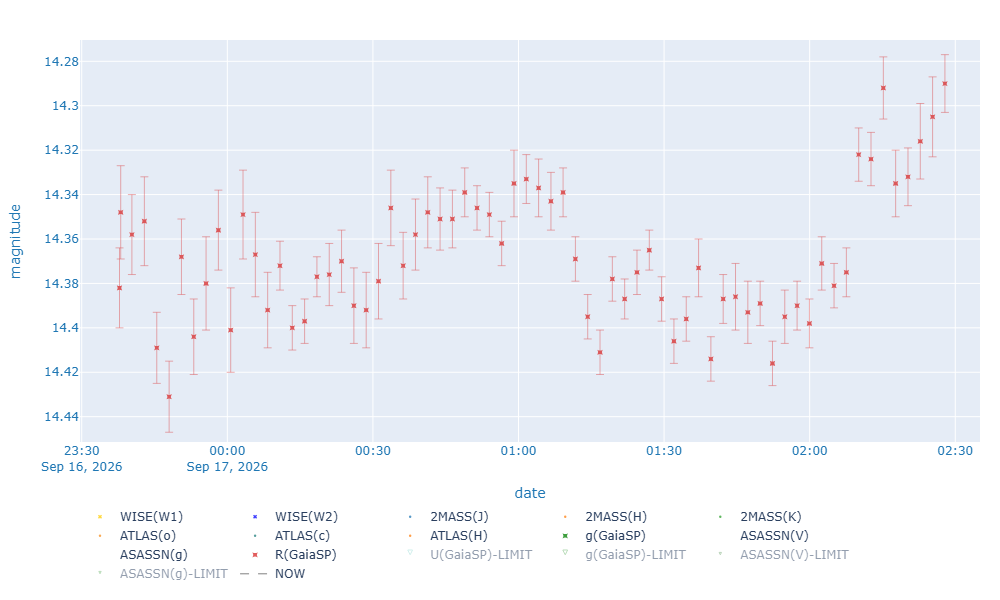
The observations covered the interval from MJD 61299.98457 to 61300.10268, corresponding to approximately 2.83 hours. Although the light curve obtained from our observations and processed with BHTOM shows noticeable brightness variations (Fig. 1), we cannot confidently identify them as superhumps. Similar variations are present in publicly available AAVSO photometry and TESS data; however, they do not exhibit a clear periodic pattern characteristic of superhumps.
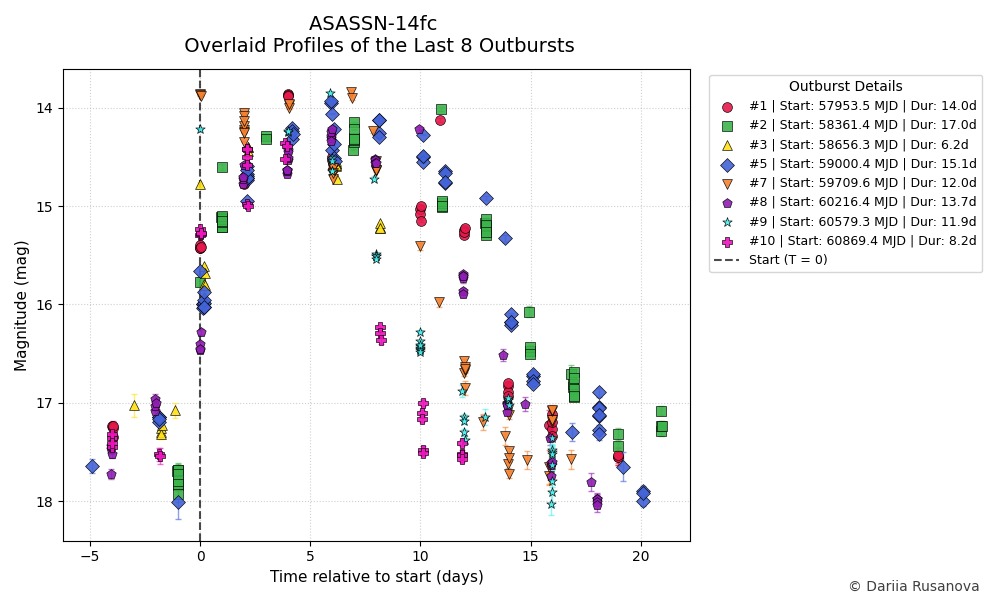
The long-term light curve shows only one type of outburst, with individual outbursts lasting approximately 10-15 days. A comparison of the outburst profiles is shown in Fig. 2. The absence of distinct superoutbursts in the long-term light curve, together with the lack of confidently detected superhumps during the present and previous outbursts, suggests that Gaia20cnt may be classified as a UGSS-type dwarf nova. All materials related to this observation are available on A.O. Simon's personal website.
Further observations are strongly encouraged. Observers are invited to upload their observations to the object's BHTOM page, where all submitted data are automatically processed: https://bhtom.space/public/targets/ASASSN-14fc.
BHTOM is based on the open-source TOM Toolkit by LCO and has been developed with funding from the OPTICON-RadioNet Pilot (ORP) of the European Union's Horizon 2020 research and innovation programme under grant agreement No 101004719 (2021-2025). This project has received funding from the European Union's Horizon Europe Research and Innovation programme ACME under grant agreement No 101131928 (2024-2028).