Gaia16amd: a new SU UMa-type dwarf nova
ATel #18005; A. O. Simon (ASPD TShNU of Kyiv), D. Yu. Rusanova (ASPD TShNU of Kyiv), F.-J. Hambsch (VVS, GEOS, BAV), W. Ogloza (UKEN, Cracow; Silesian Planetarium Chorzow), N. Karaman (Adiyaman Univ.), A. Yu. Korosko (ASPD TShNU of Kyiv), P. J. Mikolajczyk (U. Wroclaw/NCBJ, PL), L. Wyrzykowski (U. Warsaw/NCBJ, PL/EASST. eu), K. Kotysz (U. Wroclaw/U. Warsaw, PL)
on 25 Aug 2026; 09:06 UT
Credential Certification: Andrew Simon (skazhenijandrew@gmail.com)
Subjects: Optical, Request for Observations, Cataclysmic Variable, Star, Transient, Variables
Gaia16amd/MASTER OT J203529.80+063652.8/AT 2016dyj was identified by our Outbursts Alerting System as a promising candidate for an SU UMa-type dwarf nova.
Analysis of its long-term light curve revealed, in addition to normal outbursts lasting 3-4 days, brighter outbursts lasting 12-14 days, which are likely superoutbursts. The interval between superoutbursts is about 150-200 days. The most recent superoutburst began around MJD 61095 in February 2026.
Observations obtained at the Observational Station Lisnyky on August 20 showed that the object was undergoing an outburst. Given that the current outburst was about 0.5m brighter than the previous normal outburst and occurred 175d after the last superoutburst, we considered it a likely superoutburst.
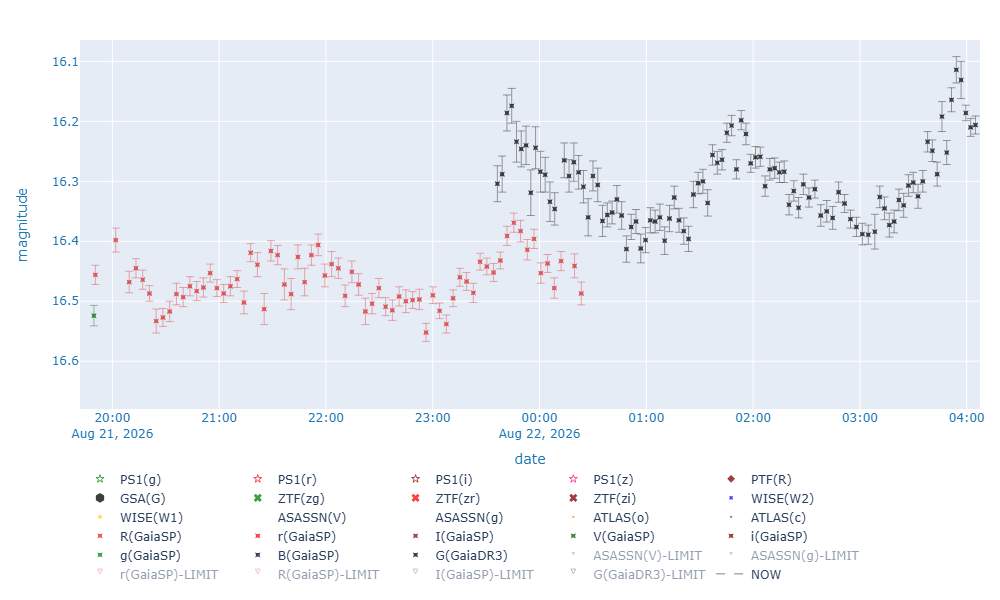
Therefore, we initiated an observational campaign using the 0.7-m f/4 AZT-8 telescope at the Observational Station Lisnyky of Taras Shevchenko National University of Kyiv, the C14 f/7 telescope at Franz-Josef Hambsch's Remote Observatory Atacama Desert (ROAD) in Chile, the 0.6-m f/6.5 ADYU60 reflector at the Observatory of Adiyaman University and the 0.7-m f/6.5 Planewave CDK-700 telescope of Planetarium Slaskie in Chorzow to search for superhumps. The resulting light curve can be found on the object's BHTOM page. The light curve obtained during the night of the first detection of superhumps is presented in Fig. 1. All materials related to this observation are available on A.O. Simon's personal website.
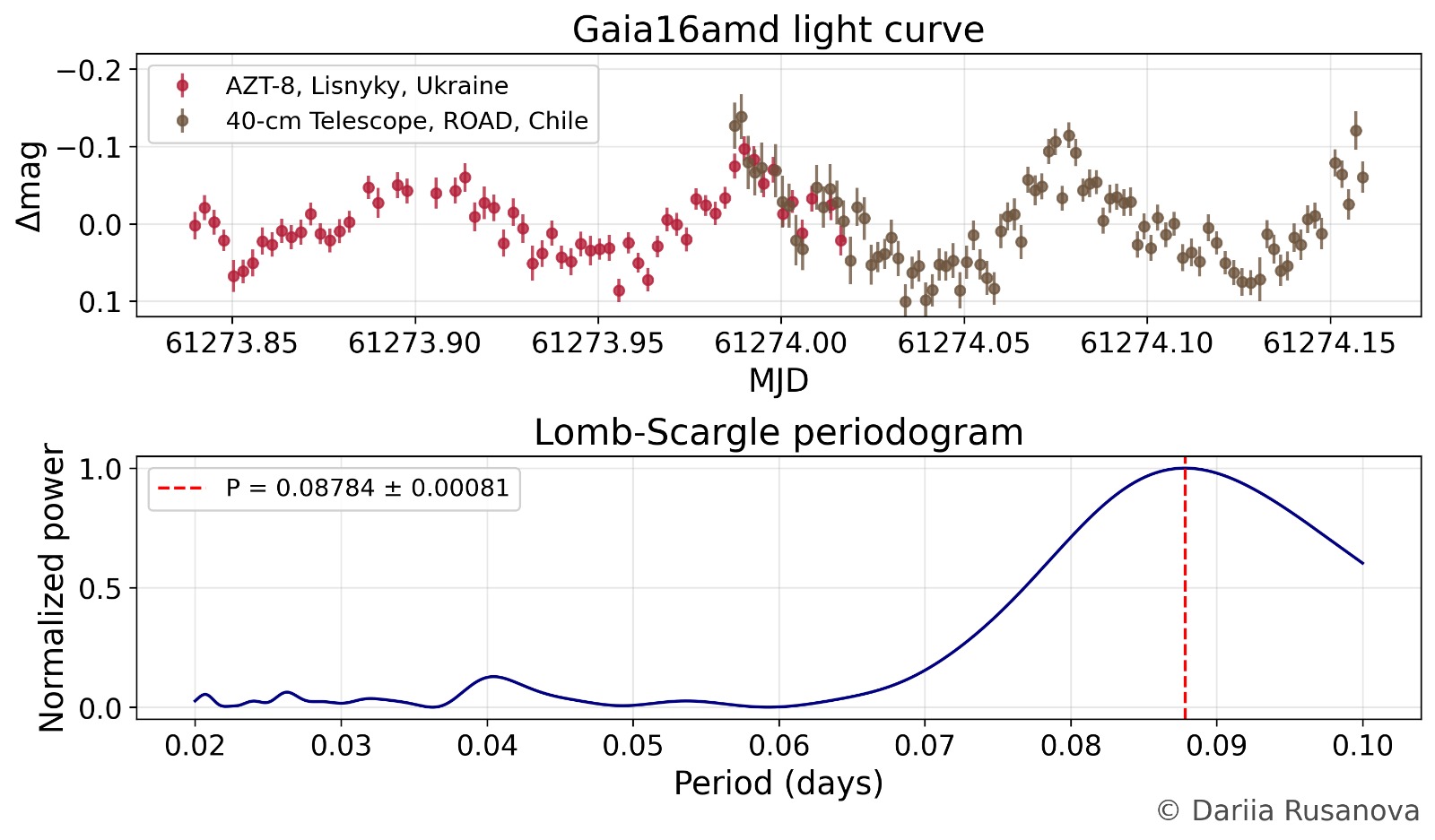
Time-resolved photometric observations obtained with the 0.7-m f/4 AZT-8 telescope covered MJD 61273.83989-61274.01620, corresponding to approximately 4.2h. Observations with the C14 f/7 telescope at Franz-Josef Hambsch's Remote Observatory Atacama Desert (ROAD) covered MJD 61273.98354-61274.16634, corresponding to approximately 4.4h. We combined these data to obtain a more accurate determination of the superhump period (Fig. 2).
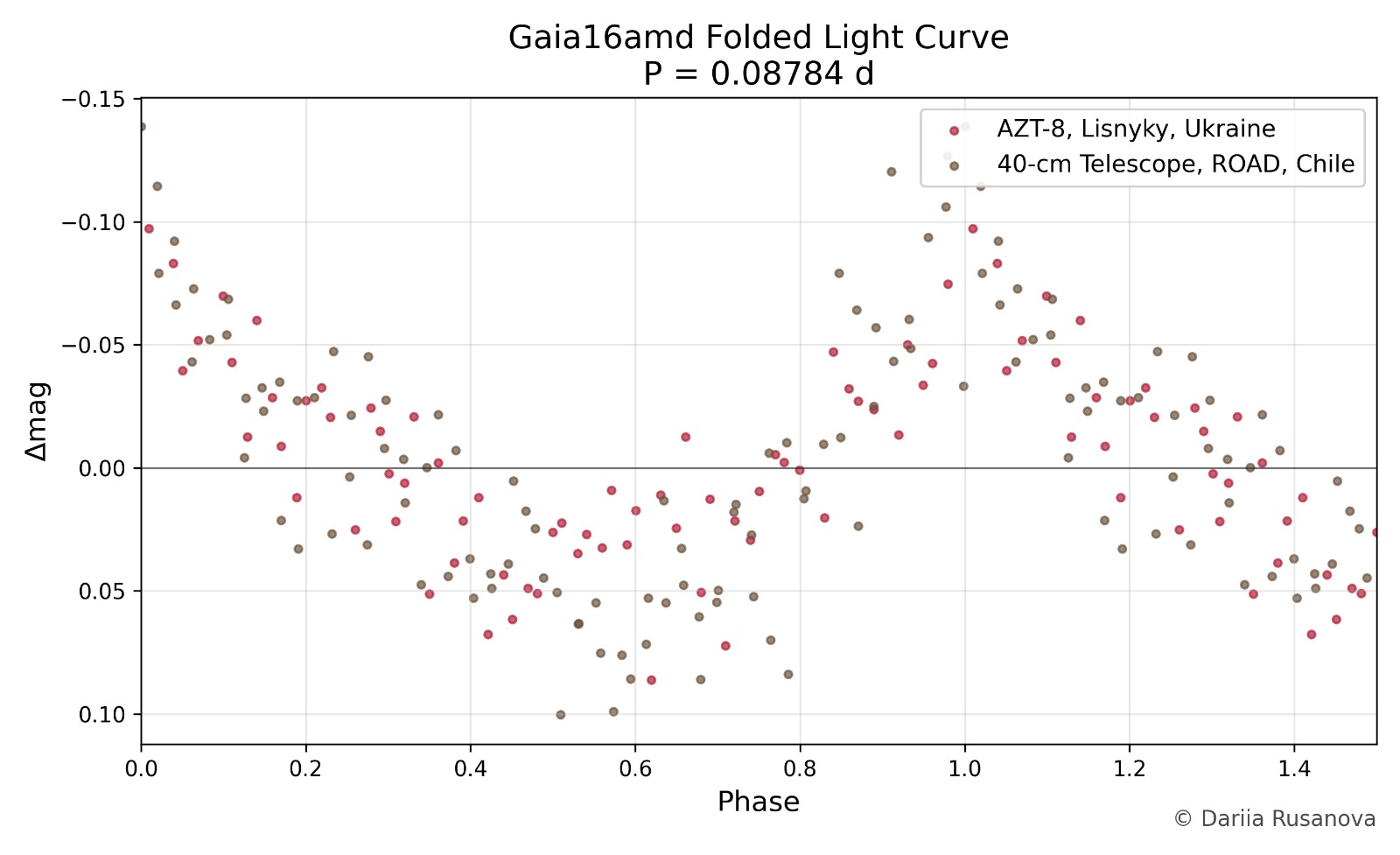
The resulting combined light curve (also see Fig. 2) clearly shows superhumps with a period of 0.0878(8)d and a peak-to-peak amplitude of about 0.2m (Fig. 3). The period was determined using a Lomb-Scargle periodogram implemented in scipy.signal.lombscargle.
The detection of superhumps together with two types of outbursts provides strong evidence that Gaia16amd is a new SU UMa-type dwarf nova observed during its ongoing superoutburst.
Further observations are strongly encouraged. Observers are invited to upload their observations to the object's BHTOM page, where all submitted data are automatically processed: https://bhtom.space/public/targets/Gaia16amd.
BHTOM is based on the open-source TOM Toolkit by LCO and has been developed with funding from the OPTICON-RadioNet Pilot (ORP) of the European Union's Horizon 2020 research and innovation programme under grant agreement No 101004719 (2021-2025). This project has received funding from the European Union's Horizon Europe Research and Innovation programme ACME under grant agreement No 101131928 (2024-2028).