Spectroscopic and multicolor photometric observations of the SU UMa-type Dwarf Nova TCP J22571796+4707418, a WZ Sge-type star candidate.
ATel #17973; Veera Vuolteenaho (NOT; U. Oulu), Vitaly Neustroev (U. Oulu)
on 16 Aug 2026; 01:19 UT
Credential Certification: Vitaly Neustroev (vitaly@neustroev.net)
Subjects: Optical, Cataclysmic Variable
A dwarf nova candidate TCP J22571796+4707418 was discovered by the NMW-TexasTech survey on 2026-08-09.3289 UTC (CBAT) at the level of 14.3 mag. To the best of our knowledge, no confirmation of this classification or further reports on this transient were published.
We obtained the object's spectra on 2026-08-10.23 UTC, ~21.6 hours after the discovery, and single-shot UBVRI images on 2026-08-11.01 UTC. We used the ALFOSC imager and spectrograph mounted on the Nordic Optical Telescope (NOT), located in Roque de los Muchachos, La Palma, Spain. At the position of the transient, we found a relatively bright source with the following magnitudes:
B=14.56 ± 0.03;
V=14.51 ± 0.01;
R=14.45 ± 0.01;
I=14.38 ± 0.01.
We did not measure the U magnitude because calibrated comparison stars were unavailable at the time.
We note that Pan-STARRS1 images of a given region of sky show 2 nearby stars, separated by less than 2 arcsec. We believe that the brighter one (Gaia DR3 1984473730558649600) is the true counterpart because it is located slightly closer to the observed transient (distance is less than 1 arcsec), and its PS1 magnitudes (g=20.83) are more consistent with the light curve of the Asteroid Terrestrial-impact Last Alert System (ATLAS). Thus, the outburst amplitude is about 6 mag.
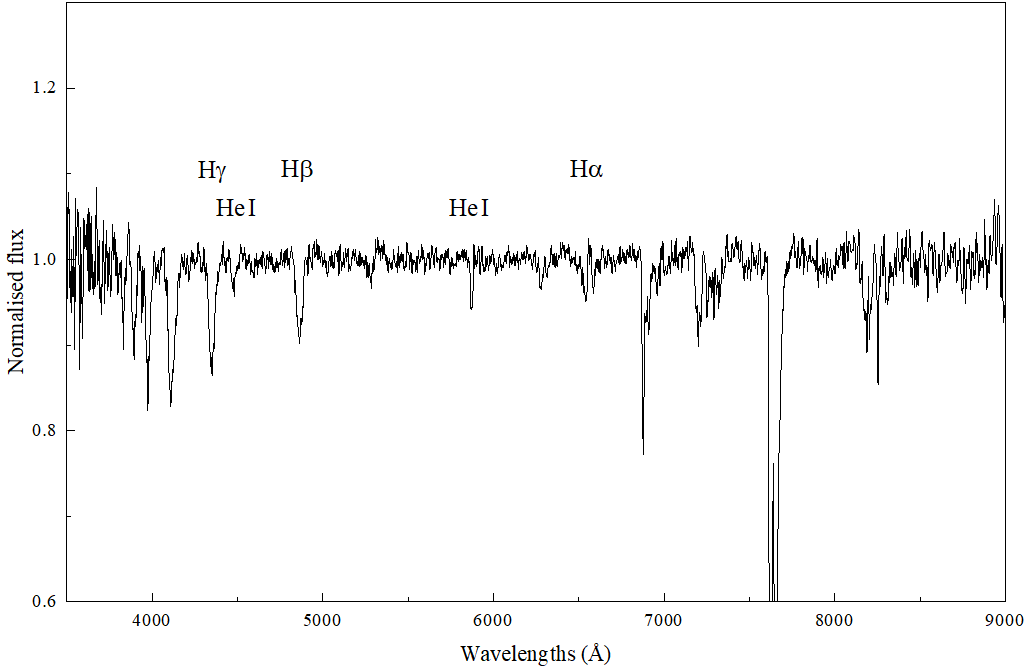
Spectra were taken with a spectral resolution of R~1000 in the spectral range of 3500 to 10200 Å, using a 1 arcsec slit and grisms #18, #19 and #20. The appearance of the spectrum is typical for a dwarf nova in outburst. It shows the broad absorption troughs of the Balmer lines with emission cores. In Hα, the emission component is relatively strong, broad, and has a double-peaked profile. Two neutral helium lines at 5875 and 4471 Å are seen in absorption, and no sign of He II 4686 is visible.
The spectral characteristics of TCP J22571796+4707418, together with its colours, are consistent with being a dwarf nova. Furthermore, the ATLAS light curve shows that the object is still in outburst and has experienced at least three other long outbursts in the past, with maxima on approximately 2017-07-22, 2021-08-21, and 2024-01-03. The outbursts' duration (about 15 days) and their shape strongly resemble superoutbursts of SU UMa-type stars. Note, however, that we see no clear evidence for normal, short-duration outbursts. This allows us to propose that TCP J22571796+4707418 can be a WZ Sge-type object, even though its outbursts' characteristics are at the lower range of typical parameters for these DNe (superoutburst intervals and their duration are a bit short, and the superoutburst amplitude is a little low), but not unique. We encourage additional time-resolved photometric and spectroscopic observations of TCP J22571796+4707418, as it is still in outburst and relatively bright, allowing its superhumps to be studied in detail.
The data presented here were obtained with ALFOSC, which is provided by the Instituto de Astrofisica de Andalucia (IAA) under a joint agreement with the University of Copenhagen and NOTSA.
Spectrum