MAXI/GSC possible detection of the brightest flare from the radio galaxy NGC 1275
ATel #17967; H. Negoro (Nihon U.), T. Mihara (RIKEN), M. Nakajima, K. Saito, T. Yokoyama, M. Wada (Nihon U.), T. Tamagawa, N. Kawai, M. Matsuoka (RIKEN), T. Sakamoto, M. Serino, S. Sugita, Y. Kawakubo, H. Hiramatsu, A. Yoshida (AGU), Y. Tsuboi, Y. Ishihara, H. Ogaki (Chuo U.), M. Shidatsu, C. Kang, M. Uenishi, T. Usuki, S. Yatsuzuka, H. Aoe (Ehime U.), I. Takahashi, Y. Yatsu (Science Tokyo), S. Nakahira, S. Ueno, H. Tomida, M. Kurihara (JAXA), Y. Ueda, K. Fujiwara, S. Kobayashi (Kyoto U.), M. Yamauchi, M. Nishio, C. Hiraizumi (Miyazaki U.), K. Yamaoka (Nagoya U.), M. Sugizaki (Kanazawa U.), W. Iwakiri (Chiba U.), T. Kawamuro (Osaka U.), S. Yamada (Tohoku U), and S. Ogawa (TUS)
on 15 Aug 2026; 00:28 UT
Credential Certification: Hitoshi Negoro (negoro@phys.cst.nihon-u.ac.jp)
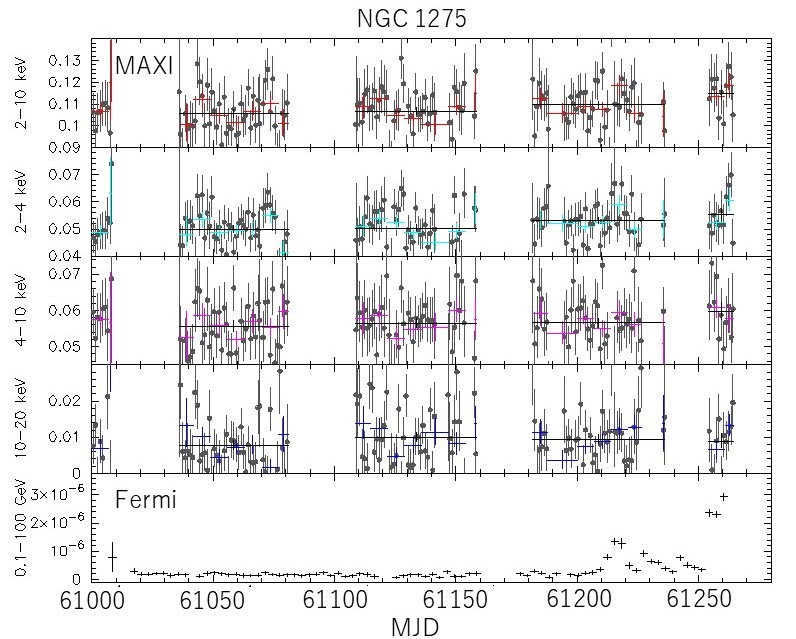
The MAXI/GSC nova alert system triggered on an X-ray enhancement from the direction of the Perseus Cluster on August 11, 2026. Using GSC data obtained with the PSF-fitting method, we find ~2-sigma continuous count excesses in the 2-4 keV band on August 10 and 11, (1.48 (+0.72/-0.68))e-2 count/cm2/s (~ 13 mCrab) and (1.86 (+0.77/-0.72)) count/cm2/s, respectively, above the steady count rate of the Perseus Cluster (5.14e-2 count/cm2/s). Such a continuous count excess is not recognized in the 4-10 keV and 10-20 keV bands. Although MAXI cannot spatially resolve the source from the cluster, the flare likely originates from the cD radio galaxy NGC 1275, which has recently exhibited the historical brightest flares in gamma-rays (ATel #17937, #17943 ), optical (ATel #17955, 17959), and very-high-energy gamma-rays (ATel #17957).
If the excess flux indeed originates from NGC 1275, the observed flux is roughly ten times higher than its previous historical record (e.g., Sinitsyna and Sinitsyna 2025, ApJ, 985, 39).
GSC and Fermi LAT light curves (obtaind from https://fermi.gsfc.nasa.gov/ssc/data/access/lat/LightCurveRepository/source.html?source_name=4FGL_J0319.8+4130)