Detection of superhumps in the ER UMa-type dwarf nova Gaia24aeg
ATel #17962; D. Yu. Rusanova (ASPD TShNU of Kyiv), A. O. Simon (ASPD TShNU of Kyiv), A. Yu. Korosko (ASPD TShNU of Kyiv), P. J. Mikolajczyk (U. Wroclaw/NCBJ, PL), L. Wyrzykowski (U. Warsaw/NCBJ, PL/EASST. eu), K. Kotysz (U. Wroclaw/U. Warsaw, PL), M. V. Matiushenko (ASPD TShNU of Kyiv), V. V. Vasylenko (ASPD TShNU of Kyiv)
on 12 Aug 2026; 20:16 UT
Credential Certification: Andrew Simon (skazhenijandrew@gmail.com)
Subjects: Optical, Request for Observations, Cataclysmic Variable, Transient, Variables
Gaia24aeg/AT 2024re/ASASSN-18hr is an ER UMa-type dwarf nova characterized by frequent superoutbursts, with a typical superoutburst recurrence time of 55-65 days. We therefore initiated photometric monitoring of the system with our Outbursts Alerting System to search for the next superoutburst.
A new outburst was detected in the BHTOM light curve, and its timing was consistent with the expected occurrence of the next superoutburst. Given the approximately 60-day recurrence interval of the superoutbursts and the timing of the current event, the observed outburst was considered a likely superoutburst. Time-resolved photometric observations were subsequently carried out with the 0.7-m f/4 AZT-8 telescope at the Observational Station Lisnyky of Taras Shevchenko National University of Kyiv to search for superhumps.
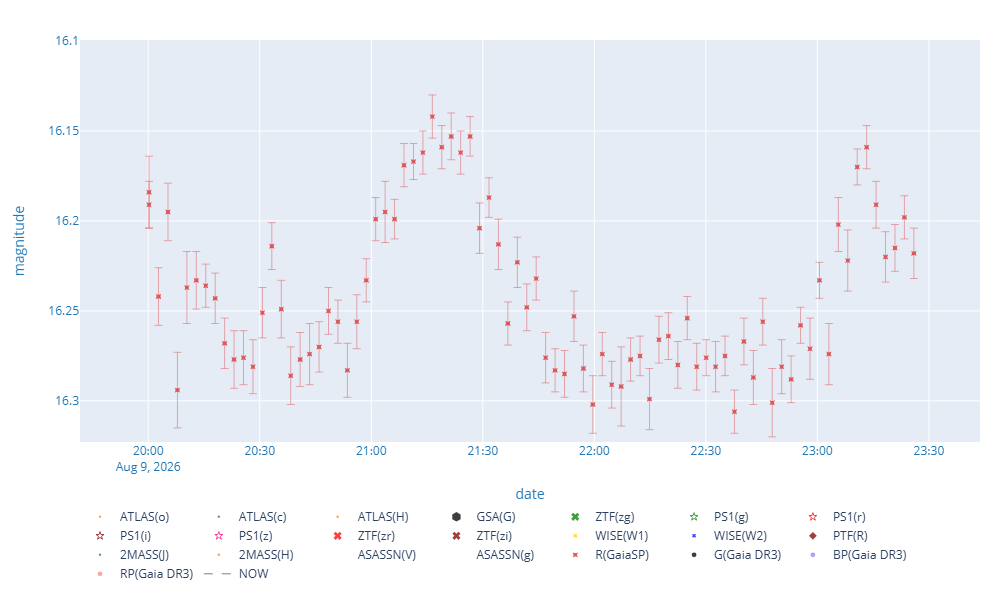
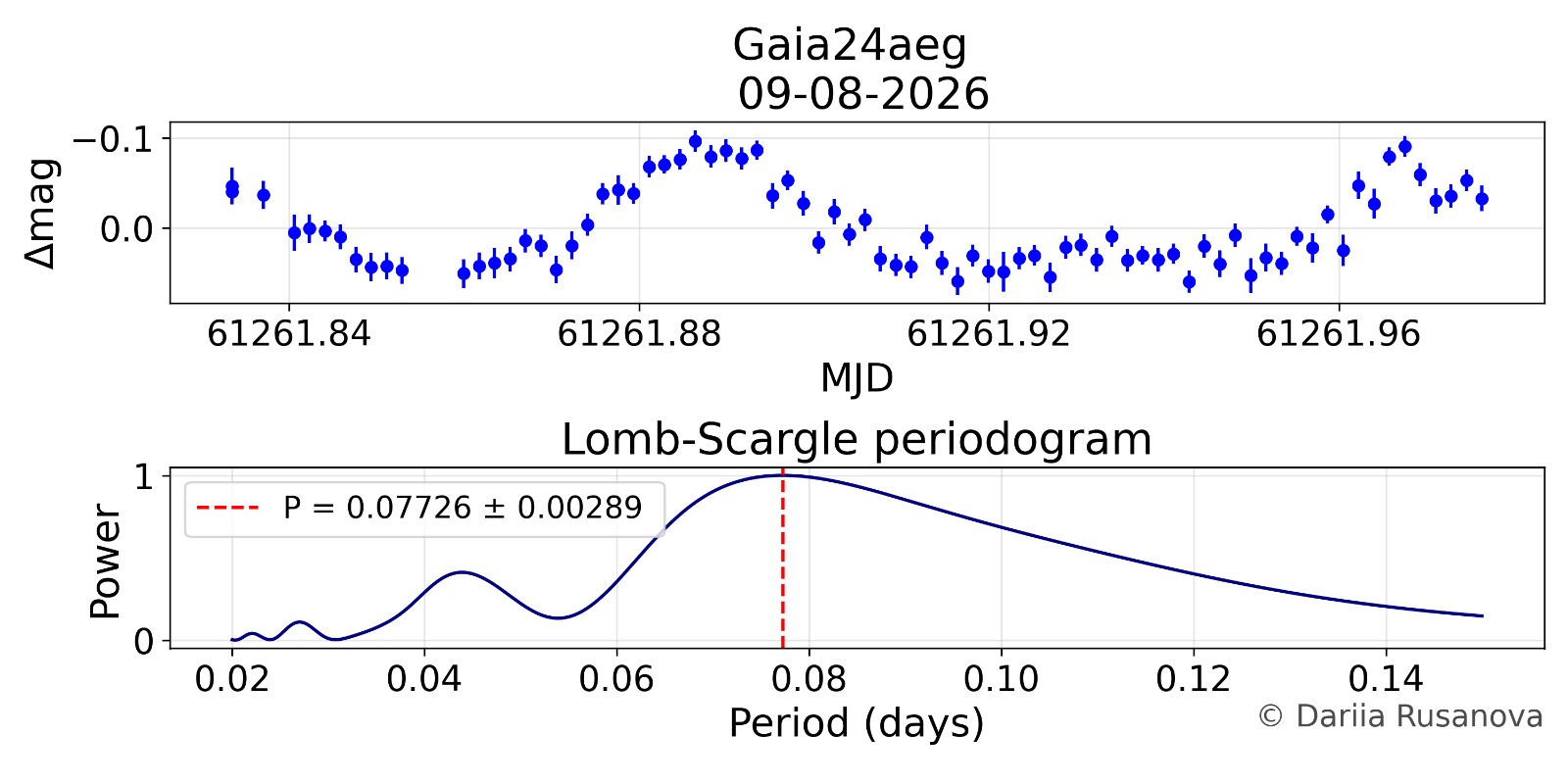
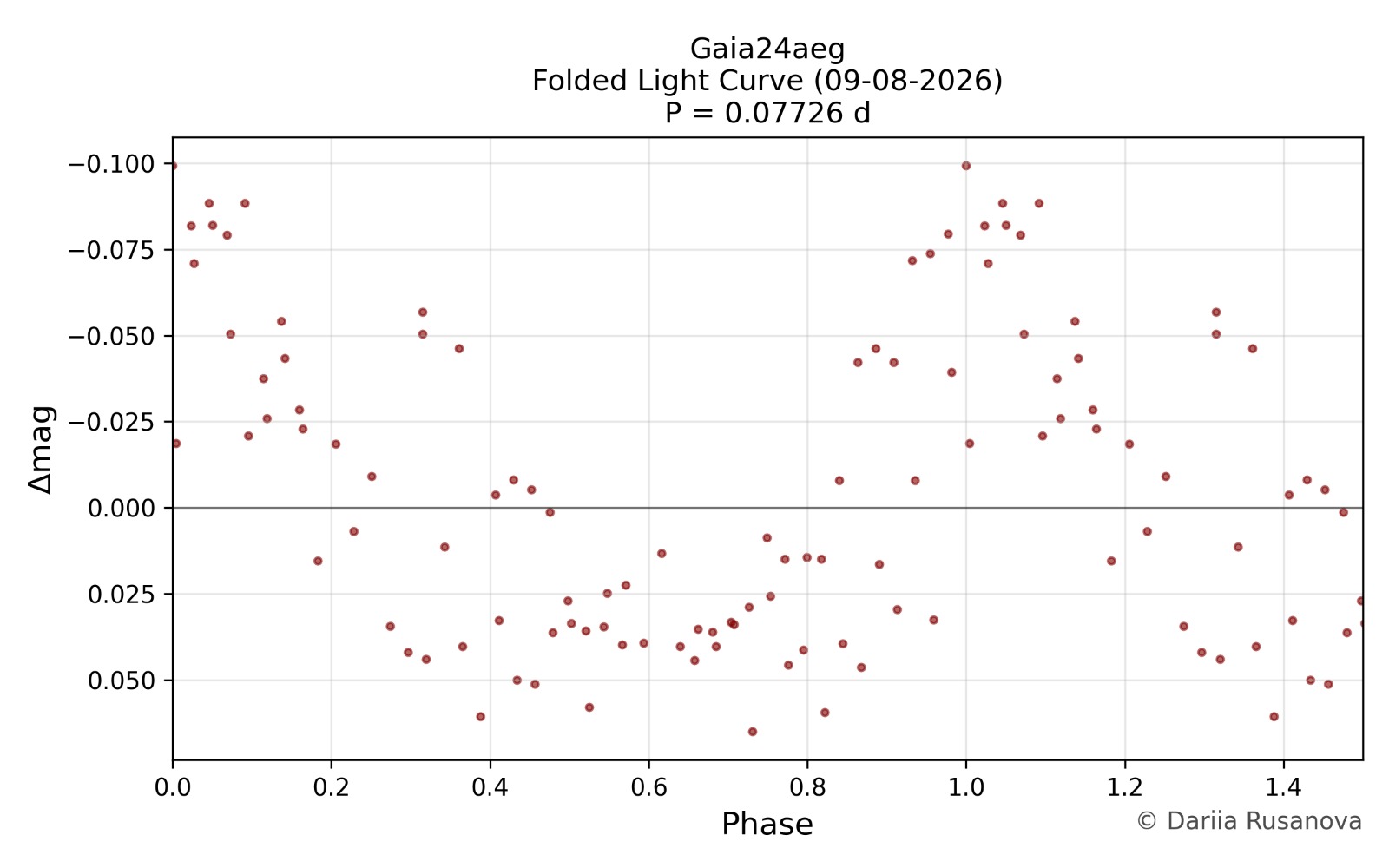
The observations covered the interval from MJD 61261.83348 to 61261.97635, corresponding to approximately 3.4 hours. The resulting light curve on the BHTOM object's page (Fig. 1) shows clear superhumps with a period of 0.077(3)d (Fig. 2) and a peak-to-peak amplitude of about 0.15m (Fig. 3). The superhump period was determined using a Lomb-Scargle periodogram implemented in scipy.signal.lombscargle. All the materials can be found on A.O. Simon's personal website.
The detection of superhumps during the current outburst supports its identification as a superoutburst and is consistent with the ER UMa-type classification of Gaia24aeg.
Further observations are strongly encouraged. Observers are invited to upload their observations to the object's BHTOM page, where all submitted data are automatically processed: https://bhtom.space/public/targets/Gaia24aeg.
BHTOM is based on the open-source TOM Toolkit by LCO and has been developed with funding from the OPTICON-RadioNet Pilot (ORP) of the European Union's Horizon 2020 research and innovation programme under grant agreement No 101004719 (2021-2025). This project has received funding from the European Union's Horizon Europe Research and Innovation programme ACME under grant agreement No 101131928 (2024-2028).