Optical spectroscopy of TCP J02191736+2857158 and TCP J20354364+6131329
ATel #17954; Paula Kvist (U. Oulu), Veera Vuolteenaho (NOT; U. Oulu), Vitaly Neustroev (U. Oulu)
on 10 Aug 2026; 08:16 UT
Credential Certification: Vitaly Neustroev (vitaly@neustroev.net)
Subjects: Optical, Cataclysmic Variable
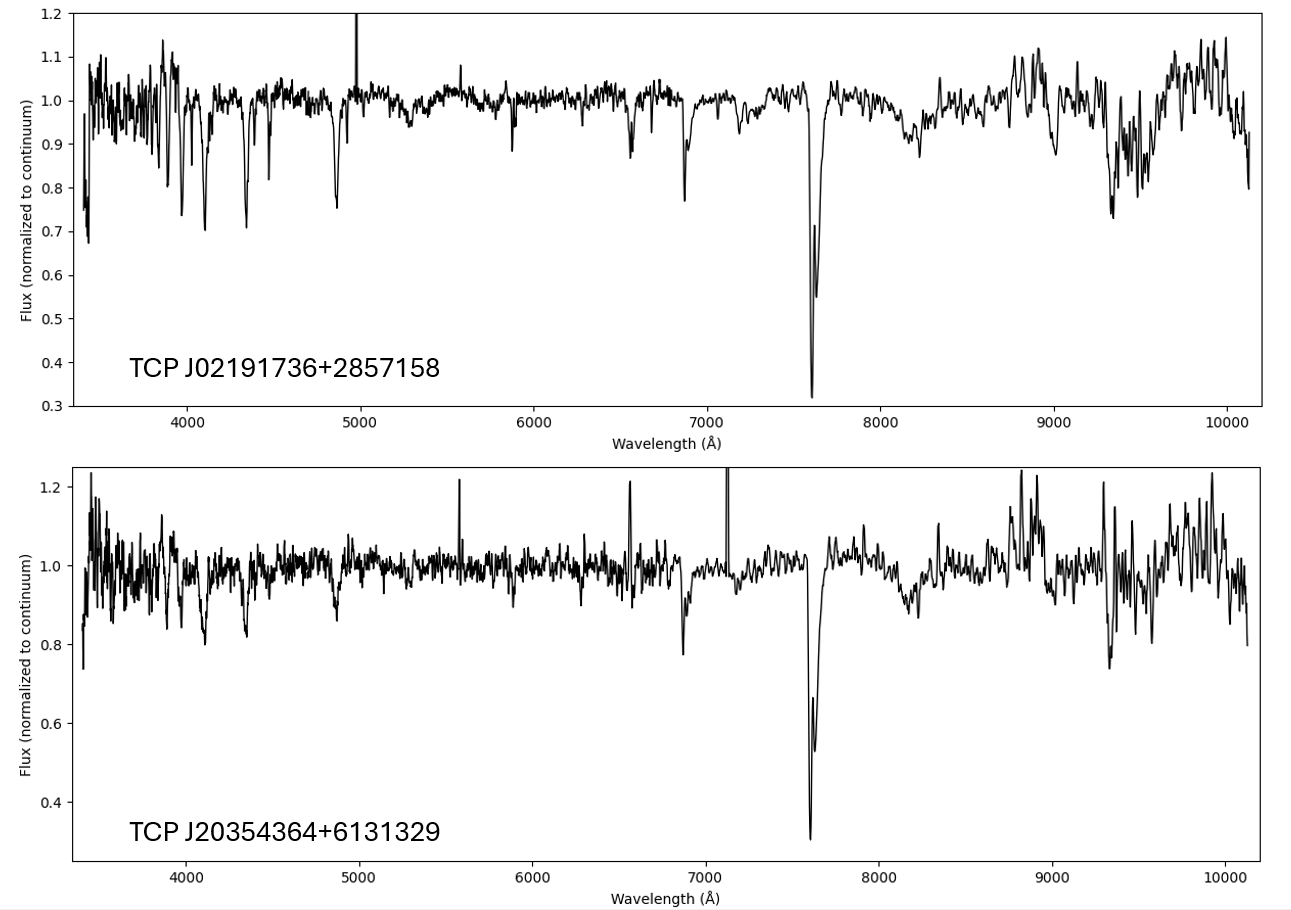
We report optical spectroscopy of two WZ Sge-type novae TCP J02191736+2857158 and TCP J20354364+6131329. The observations were carried out using the ALFOSC imager and spectrograph mounted on the Nordic Optical Telescope (NOT), located in Roque de los Muchachos, La Palma, Spain. Spectra were taken on 2026 July 26 with a spectral resolution of R~2000 in the spectral range of 3500 to 10200 Angstroms, using a 0.5" slit and grisms #18, #19 and #20.
TCP J02191736+2857158 was discovered by the NMW-TexasTech survey on 2026 July 12 (CBAT) at the level of CV=12.49(5), while a possible optical counterpart has g=20.97(3). Based on the light curve of the Asteroid Terrestrial-impact Last Alert System (ATLAS), the object has entered a rapid fading stage on 2026 August 7. Thus, the large outburst amplitude (~8.5 mag), its long duration (at least 27 days), the detection of superhumps (vsnet-alert 28195, 28196), and the appearance of the spectrum (ATel #17887) indicate that TCP J02191736+2857158 can be classified as WZ Sge-type dwarf nova.
Our spectrum of TCPJ02191736+2857158 was obtained 14 days after the previously observed spectrum reported in ATel #17887. The spectrum shows Balmer absorption lines from Halpha to at least H13. The Balmer lines show narrow emission cores. Paschen 10-13 may be visible, but the noise level is too high for a certain interpretation. In addition, we see several He I lines, such as 5875, 4922, 4471, 4381, and 4026, and Ca II 3933, all in absorption. Overall, the spectral characteristics of TCPJ02191736+2857158 are consistent with being a dwarf nova of the WZ Sge type.
TCP J20354364+6131329 was discovered on 2026 July 20 (CBAT, ATel #17912) at the level of CV=14.41(2). Its possible optical counterpart has g=21.92. Soon after the discovery, the object started exhibiting double-peaked early superhumps with a period of 0.0579(3) d (vsnet-alert 28193), undoubtedly confirming TCP J20354364+6131329 as a WZ Sge-type object. The ATLAS light curve shows that the object is still in outburst.
We observed TCP J20354364+6131329 six days after observations reported in ATel #17912. The spectrum shows Balmer absorption lines from Halpha to at least H10. An emission core can be seen in Halpha and Hbeta. In Halpha, an emission core may have a double-peak structure, although a better-quality spectrum will be needed to confirm that. No emission can be seen in any other lines. There is also a wide absorption line of He I at 4471 Angstrom and a narrower line at 5875 Angstrom, but no other helium lines are found.
The data presented here were obtained with ALFOSC, which is provided by the Instituto de Astrofisica de Andalucia (IAA) under a joint agreement with the University of Copenhagen and NOTSA.
Spectra