Detection of Superhumps during a Superoutburst in Gaia20ffw
ATel #17951; D. Yu. Rusanova (ASPD TShNU of Kyiv), F.-J. Hambsch (VVS, GEOS, BAV), A. O. Simon (ASPD TShNU of Kyiv), P. J. Mikolajczyk (U. Wroclaw/NCBJ, PL), L. Wyrzykowski (U. Warsaw/NCBJ, PL/EASST. eu), K. Kotysz (U. Wroclaw/U. Warsaw, PL)
on 9 Aug 2026; 08:57 UT
Credential Certification: Andrew Simon (skazhenijandrew@gmail.com)
Subjects: Optical, Request for Observations, Cataclysmic Variable, Transient, Variables
We report the detection of superhumps during a superoutburst in the cataclysmic variable Gaia20ffw/AT2020znz/ASASSN-18jq, which was detected by our Outbursts Alerting System.
The BHTOM long-term light curve of Gaia20ffw indicates that the object exhibits two distinct types of outbursts: relatively short normal outbursts and longer, brighter events that are likely superoutbursts. A new outburst was detected in the BHTOM light curve of the object beginning on 2026 August 1. The Outbursts Alerting System informed us that Gaia20ffw remained in an elevated-brightness state on August 5, indicating that the event had already lasted for at least four days. The long duration of the event suggested that Gaia20ffw might be undergoing a superoutburst. VSNET-Alert #27614 suggested that ASASSN-18jq(Gaia20ffw) might be an SU UMa star.
Time-resolved photometric observations were therefore performed with the C14 f/7 telescope at Franz-Josef Hambsch's Remote Observatory Atacama Desert (ROAD) in Chile to search for superhumps, the characteristic photometric signature of SU UMa-type superoutbursts.
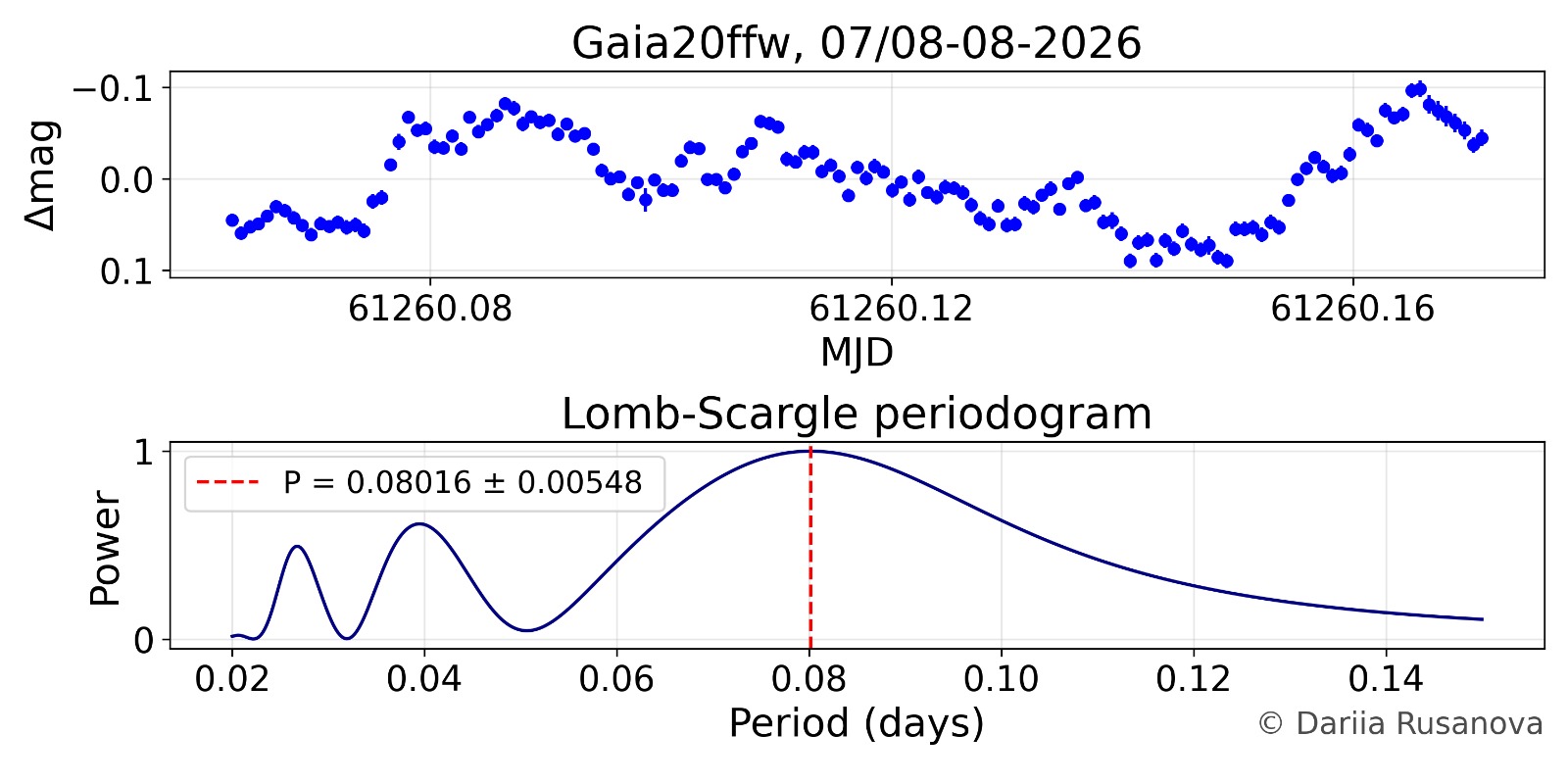
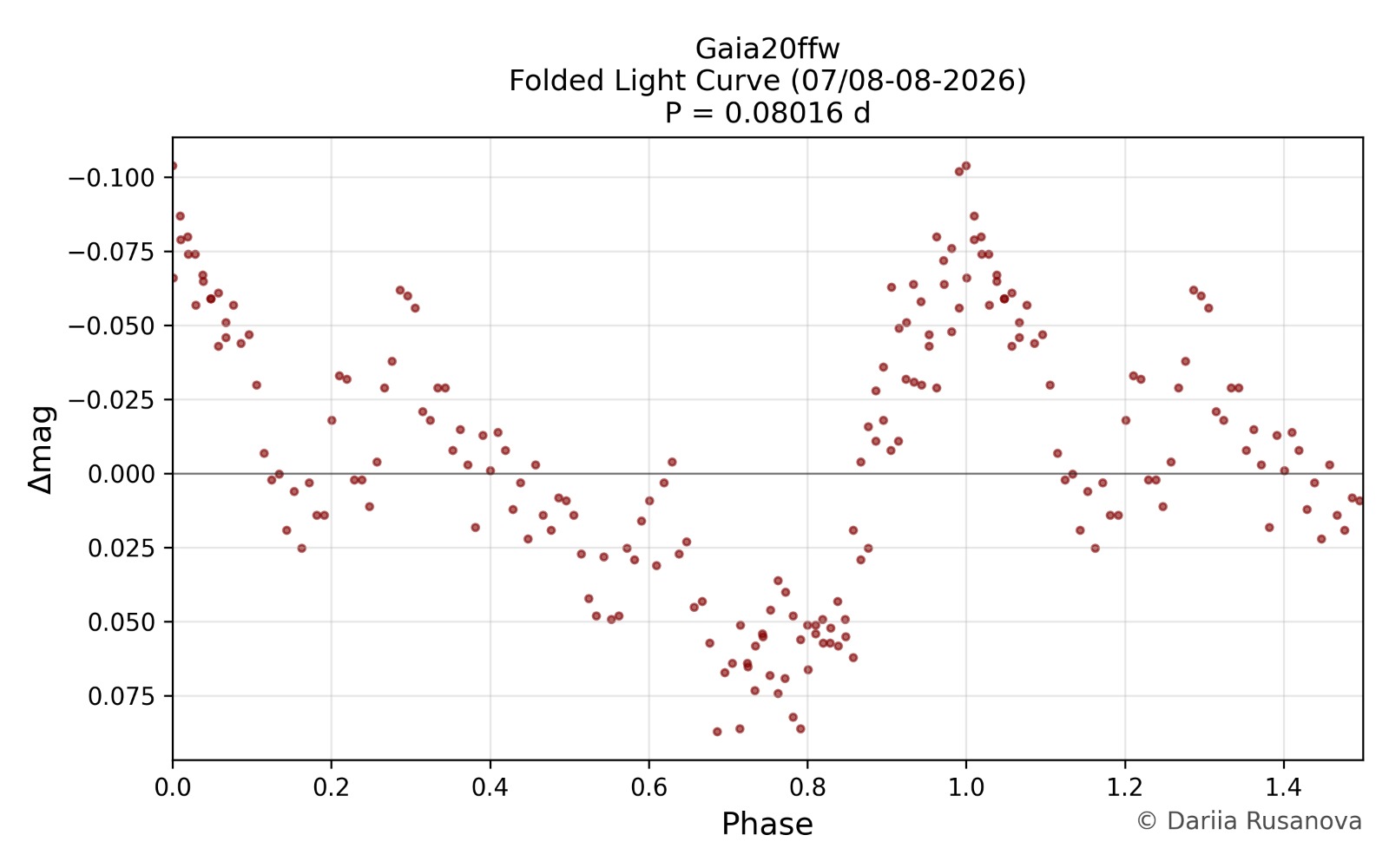
The observations covered the interval from MJD 61260.06284 to 61260.17119, corresponding to approximately 2.6 hours. The resulting light curve (Fig. 1) clearly shows superhumps with a period of 0.0801(55)d and a peak-to-peak amplitude of about 0.2m (Fig. 2). The superhump period was determined using a LombâScargle periodogram implemented in scipy.signal.lombscargle. The phase-folded light curve also shows a possible secondary hump around phase 0.3. These results confirm that Gaia20ffw is an SU UMa-type dwarf nova.
Further observations are strongly encouraged. Observers are invited to upload their observations to the object's BHTOM page, where all submitted data are automatically processed: https://bhtom.space/public/targets/Gaia20ffw.
BHTOM is based on the open-source TOM Toolkit by LCO and has been developed with funding from the OPTICON-RadioNet Pilot (ORP) of the European Union's Horizon 2020 research and innovation programme under grant agreement No 101004719 (2021-2025). This project has received funding from the European Union's Horizon Europe Research and Innovation programme ACME under grant agreement No 101131928 (2024-2028).