New faint optical activity in the black hole transient IGR J17091-3624
ATel #17907; D. M. Russell, D. M. Bramich, D. Akl, Y. J. Yang (NYU Abu Dhabi), A. Marino (USACH & ICE-CSIC), P. Saikia (Yale), M. C. Baglio, K. Alabarta (INAF-OAB), F. Lewis (Faulkes Telescope Project & The Schools' Observatory, LJMU), (INAF-OAB)
on 19 Jul 2026; 18:46 UT
Credential Certification: David M. Russell (dave.russell5@gmail.com)
Subjects: Optical, X-ray, Binary, Black Hole, Transient
Referred to by ATel #: 17919
IGR J17091-3624 is a low-mass X-ray binary hosting a black hole primary. The source was discovered in 2003 (ATel #149), and several outbursts have been reported since then, the most recent being in 2025 (e.g. ATel #17034, #17065, #17221). We have been monitoring IGR J17091-3624 with the 1m and 2m telescopes of the Las Cumbres Observatory (LCO) network, as part of a monitoring campaign of ~50 low-mass X-ray binaries (Lewis et al. 2008). LCO images are processed and reduced, and magnitudes are extracted and calibrated using a real-time data analysis pipeline, the "X-ray Binary New Early Warning System" (XB-NEWS; see Russell et al. 2019, Saikia et al. 2026 for details).
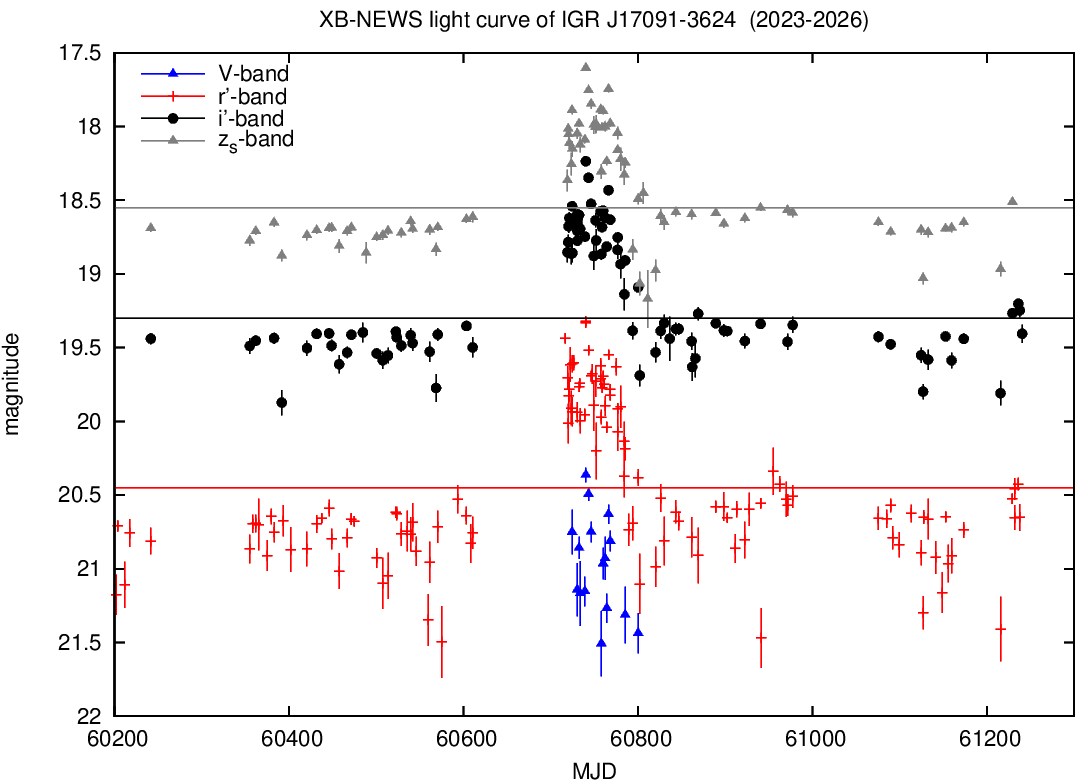
Since the end of its 2025 outburst (ATel #17166, #17221), IGR J17091-3624 has remained in quiescence at optical wavelengths, with magnitudes in the range r' ~ 20.5 - 21.5, i' ~ 19.3 - 19.8, z_s ~ 18.6 - 19.1. A slight brightening is seen recently in all three filters:
2026-06-24 (MJD 61215.6): r' = 21.41 +/- 0.22, i' = 19.81 +/- 0.08, z_s = 18.97 +/- 0.05,
2026-07-08 (MJD 61229.3): r' = 20.52 +/- 0.03, i' = 19.27 +/- 0.02, z_s = 18.51 +/- 0.02,
2026-07-10 (MJD 61231.6): r' = 20.46 +/- 0.07,
2026-07-11 (MJD 61232.3): r' = 20.65 +/- 0.08,
2026-07-14 (MJD 61235.9): r' = 20.43 +/- 0.04, i' = 19.20 +/- 0.02,
2026-07-16 (MJD 61237.7): r' = 20.65 +/- 0.09, i' = 19.25 +/- 0.05,
2026-07-19 (MJD 61240.5): i' = 19.41 +/- 0.06.
Note that these magnitudes (including the historical light curve) include some flux from two faint stars close in angular separation to the source. In Saikia et al. (2026), the magnitudes were corrected for this blend of stars; here they are not corrected. The recent brightening most likely started between June 24th and July 8th, but remains at a very low level. The most recent point, on 2026-07-19 in i'-band only, is consistent with the quiescent range. Multi-wavelength observations are encouraged, to confirm the brightening and monitor the activity in this recurrent black hole LMXB. A link to the light curve is below. We will continue to monitor the source with LCO.
2023-2026 XB-NEWS light curve of IGR J17091-3624