Evolution of Nova Aql 2026 (V2104 Aql) from discovery to the t2 phase
ATel #17900; U. Munari (INAF Padova), S. Dallaporta, A. Maitan, G. L. Righetti, A. Vagnozzi and P. Valisa (ANS Collaboration)
on 16 Jul 2026; 15:02 UT
Credential Certification: U. Munari (ulisse.munari@oapd.inaf.it)
Subjects: Optical, Cataclysmic Variable, Nova, Transient
The transient AT 2026rdg (discovered via ZTF by M. Ning and H. Lin at g = 14.45 mag on July 1.305 UT) was classified in ATel #17867 and #17868 as a highly reddened FeII-type nova, which was consequently designated as Nova Aql 2026 = V2104 Aql in CBET #5711. Since discovery, we have been carrying out daily photometric and spectroscopic monitoring of the object, which has just reached the t2 phase (declining by 2 mag from maximum brightness).
BVRI (Landolt) and gri (Sloan) photometry of Nova Aql 2026 is acquired daily with ANS Collaboration telescopes ID 0310, 1302, 1512, and 2202. Lightcurves in all bands are presented here:photometry.
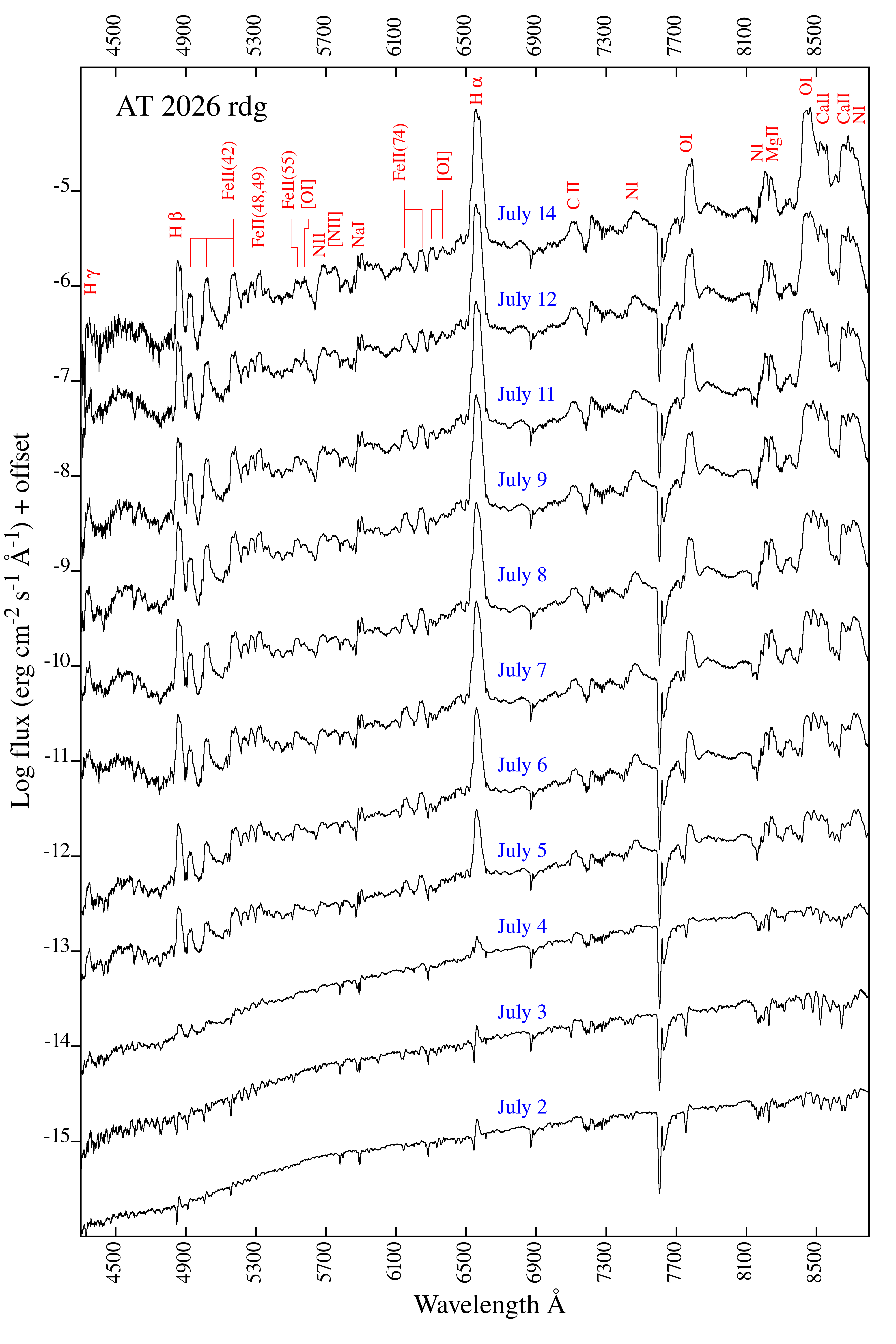
Low-resolution, flux-calibrated spectroscopy (range 3850-9050 Ang, 1.44 Ang/pix dispersion) is recorded daily with the Varese 0.84m telescope and its Multi-Mode Spectrograph, while Echelle high-resolution spectra are obtained every third day with the same equipment (resolving power 18,000, range 4000-9100 Ang). The spectroscopic evolution of Nova Aql 2026 from low-resolution observations is shown here:
spectroscopy.
The rise of Nova Aql 2026 to maximum was characterized by a halt, lasting between days -2.0 and -1.0 prior to maximum. The shape of the halt strongly depends on the photometric band: from a sort of double-peaked maximum in the B band, it flattens out to a constant brightness phase toward the I band. During the halt, the spectra remained self-similar, showing feeble emission in Balmer, FeII, and OI lines, with P-Cyg absorptions at velocities of -680 to -730 km/s depending on the ion species. From a low-order spline interpolation of the lightcurve, the magnitude and time of passage at maximum brightness are as follows: 13.50 mag on Jul 3.1 UT for the B band, 11.036 on Jul 4.9 for V, 9.217 on Jul 5.0 for R, and 7.530 on Jul 5.1 for I. Spectroscopically, the passage at maximum brought a rapid increase in the intensity of the emission lines, with many new ones appearing (such as CaII, MgII, CII, NaI, and NI), while P-Cyg absorptions sharply weakened in strength. On the Echelle spectrum for Jul 6.85 UT, P-Cyg absorptions were observed at -1745 and -1110 km/s for OI 7772 Ang and were feeble at -1960, -910, and -400 km/s for Halpha, with emission components having FWHM=1700 and 1870 km/s, respectively.
The post-maximum decline has been smooth without glitches, with B-V and r-i colors getting bluer, and V-R, V-I, and g-r turning redder. Passage at t2 in the V band was observed on July 13.9 UT, at a color B-V=+2.12. The value t2(V)=9.0 days classifies Nova Aql 2026 among the "very fast" novae following Warner (1995). The latest photometric observation, recorded on Jul 16.068 UT (1.2 days after the passage at t2), shows an unexpected rebound in brightness by 0.25 mag in the B and V bands, which deserves monitoring in the following days. The spectra during the decline remained rather self-similar, with constant FWHM for the emission lines, no increase in the ionization degree, and only the emergence of [OI] 5577,6300,6364 in emission.
Compared with intrinsic values reported by van den Bergh and Younger (1987, A&AS 70, 125), the B-V colors at maximum and at t2 indicate a reddening of E(B-V)=2.5 and 2.1, respectively. Interstellar KI 7698 supports E(B-V)=2.45 following Munari and Zwitter (1997, A&A 318, 269), and DIB 6614 returns E(B-V)=2.65 using the calibration by Munari (2014, ASPC 490, 183), for an average value of E(B-V)=2.45 +/- 0.18 for the interstellar reddening affecting Nova Aql 2026.