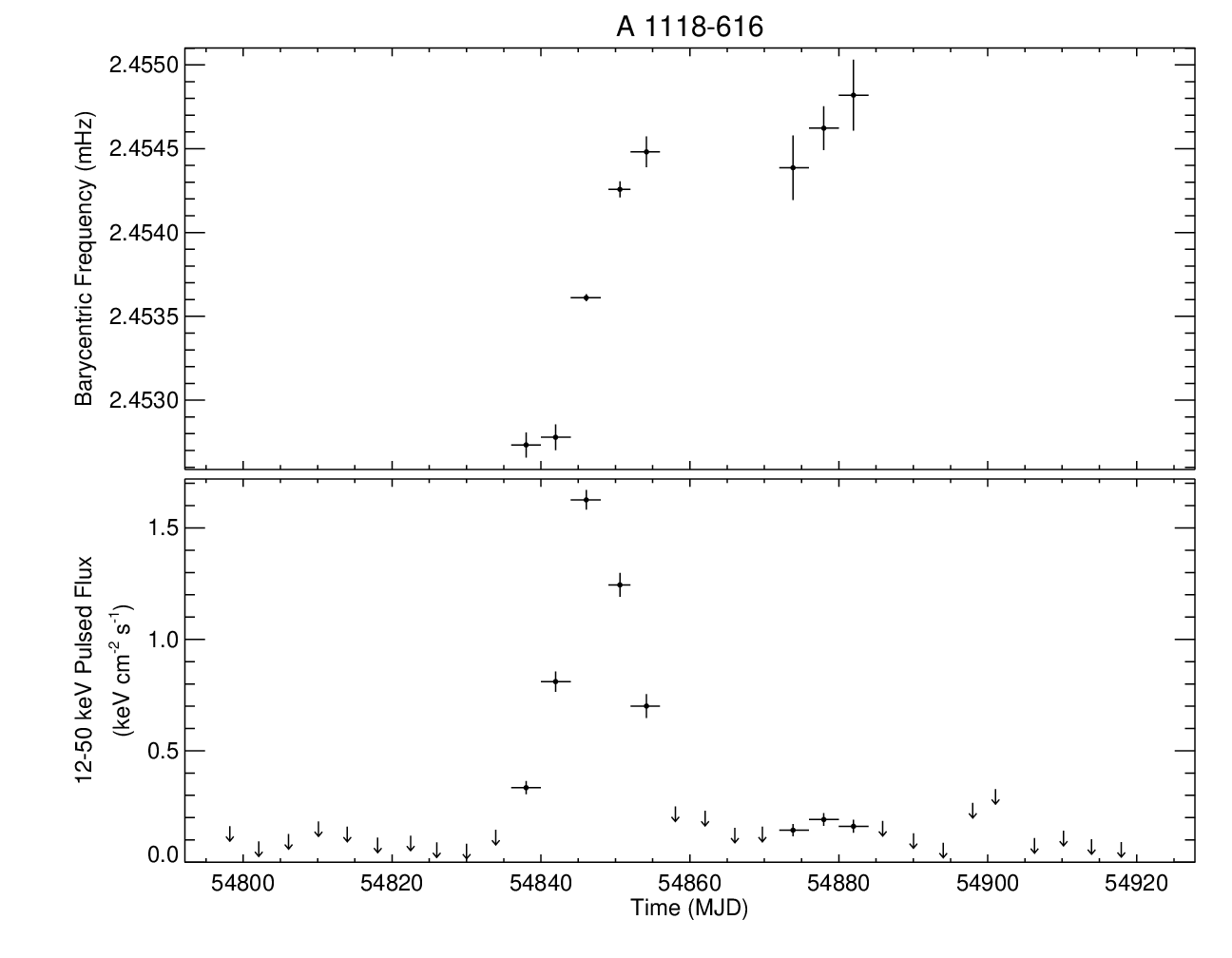
Fermi/GBM detects outburst from Be/X-ray binary A 1118-616.
ATel #17690; P. Jenke (UAH), Colleen Wilson-Hodge (NASA/MSFC), C. Malacaria (INAF/OAR)
on 19 Feb 2026; 18:32 UT
Credential Certification: Peter Jenke (peter.a.jenke@nasa.gov)
Subjects: X-ray, Gamma Ray, Binary, Neutron Star, Transient, Pulsar
Referred to by ATel #: 17853
The GBM Accreting Pulsar Project (GAPP) detected pulsations from the transient Be/X-ray binary A 1118-616 between January 16, 2026 and February 13, 2026. The outburst, on January 25, 2026, reached a peak RMS pulsed flux of 2.42 +/- 0.03 keV cm-2 s-1 (238 mCrab). The frequency, uncorrected for orbit, was 2.4500 mHz by the end of the outburst. GAPP last detected this source in 2009 between January 5 and February 22 when it reached a peak flux of 123 mCrabs in the 12-50 keV band. The two outbursts detected with GBM were separated by 17 years. Previous outbursts reported in literature were in 1975 (Elyes, C. J., et al. 1975) and 1992 (Coe, M. J., et al. 1994), also showing a 17 year separation. This suggests a long-term period of ~17 years in this system (See ATeL #17615, Coe. M. J.). Other observations of A 1118-616 may be found at ATeLs #17613, #17616, #17626, and #17627.
GAPP observation of A 118-616