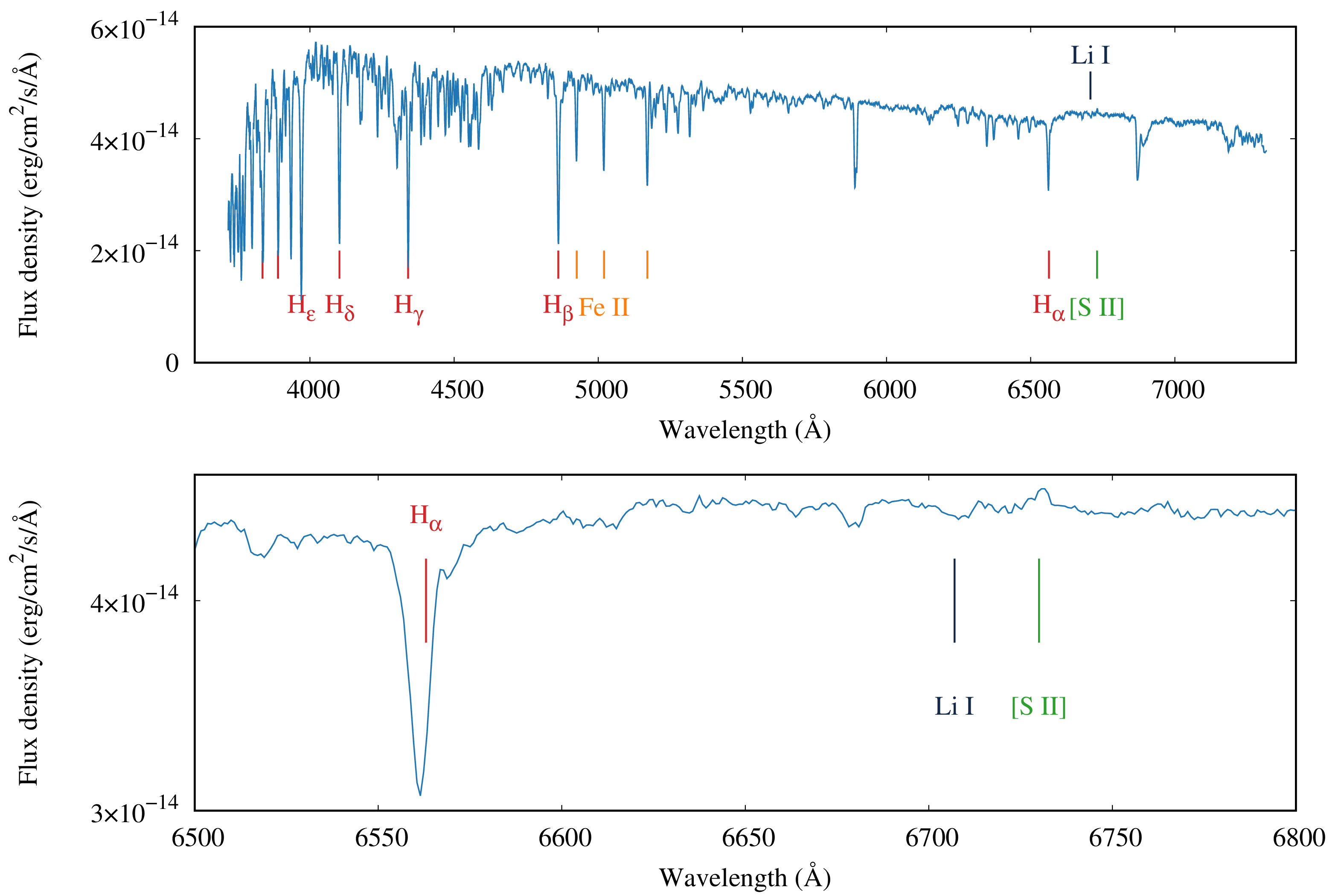
FUor-like absorption-dominated spectrum of TCP J21220926+4926242
ATel #17519; V. Yu. Kochkina, M. I. Chazov, A. I. Kolbin (SAO RAS), A. N. Tarasenkov, S. A. Naroenkov, M. A. Nalivkin (INASAN), A. V. Dodin (SAI), E. Saveleva, A. Getmansky, V. Belousov, S. A. Korotkiy (Astroverty, Ka-Dar), E. Aydi, K. V. Sokolovsky (TTU)
on 1 Dec 2025; 23:10 UT
Credential Certification: Kirill Sokolovsky (kirx@scan.sai.msu.ru)
Subjects: Optical, Transient, Variables, Young Stellar Object, Pre-Main-Sequence Star
The optical transient TCP J21220926+4926242 (J2122) was discovered
at unfiltered magnitude 12.8 on 2025-11-18.4214 UTC by S. Kaneko
using a Canon EOS 6D mark2 DSLR camera with a 200mm f/3 telephoto
lens. Follow-up photometry with the NMW survey camera (135mm f/2.0
telephoto lens + unfiltered ST-8300M CCD) showed gradual
brightening over the following week reaching CV=12.3
on 2025-11-29.7230. ASAS-SN (Shappee et al. 2014, ApJ, 788, 48;
Kochanek et al. 2017, PASP, 129, 104502) photometry reveals
the brightening started as early as 2025-10-25.3164 when
the transient was first detected at g=16.9. The ASAS-SN lightcurve
shows no previous outbursts since at least 2015.
We performed BVRI photometry of J2122 using a 50-cm f/8
Ritchey-Chretien robotic telescope of the Institute of Astronomy of
the Russian Academy of Sciences, equipped with an FLI Proline 16803
CCD camera. Observations were obtained with 90s exposures. Field
stars with magnitudes from Gaia DR3 Synthetic Photometry
(Gaia Collaboration 2023, A&A, 674, A33) served as comparison stars.
The resulting magnitudes are:
2025-11-23.8311 B 13.11 +/-0.01
2025-11-23.8140 V 12.53 +/-0.01
2025-11-23.8337 R 12.07 +/-0.01
2025-11-23.8349 I 11.24 +/-0.01

2025-11-24.8761 B 13.05 +/-0.03
2025-11-24.8743 V 12.47 +/-0.02
2025-11-24.8730 R 12.01 +/-0.01
2025-11-24.8777 I 11.18 +/-0.01

2025-11-25.6848 V 12.41 +/-0.01
Spectroscopic observations of J2122 were performed on the nights
of 2025-11-25 and 27 with the 6-m BTA telescope of the Special
Astrophysical Observatory using the focal reducer SCORPIO-2 in
long-slit mode (Afanasiev & Moiseev 2011, BaltA, 20, 363).
The VPHG1200@540 grating with 1" slit provided wavelength
coverage 3600-7200 A at ~5.2 A resolution. The first night was
cloudy, while the second had good observing conditions. Spectra
were stacked to increase signal-to-noise.
The spectrum shows a continuum with strong absorption lines.
It resembles that an F5-type star with multiple Fe II lines typical
of Herbig AeBe stars. Li I 6707 A absorption, indicative of a
pre-main-sequence star, is marginally visible in the spectrum.
[S II] 6730 A emission, often associated with jets from young
stellar objects, is present. No other prominent emission features
are detected, including Ca II H and K. The Balmer lines show no
P Cyg profiles indicative of wind. The H-alpha profile appears
slightly blueshifted, suggesting possible partial infilling by
redshifted emission.
The spectrum resembles absorption-dominated FU Ori stars V1515 Cyg
and V1057 Cyg (Hillenbrand et al. 2019, AJ, 158, 240).
FUor Gaia18dvy displayed an absorption-dominated spectrum at one
epoch during its rise (Szegedi-Elek et al. 2020, ApJ, 899, 130).
While FUor spectra are shaped by accretion disks (continuum and
absorption) and winds (not clearly observed here), EX Lupi-type
(EXor) outbursts show emission-line dominated spectra interpreted
as magnetospheric accretion. The absorption-dominated spectrum and
isolated >4 magnitude outburst suggest J2122 may be a FUor.
Alternatively, the brightening could represent emergence from an
exceptionally long UXor-type dust obscuration event. Further
photometric monitoring and spectroscopy (that could reveal
the presence of wind) are needed to distinguish between these
possibilities.
The stacked 6-m BTA spectrum of J2122.