Photometric and spectroscopic follow-up observations of AT 2025abao: A luminous symbiotic nova in M31?
ATel #17476; A. Skopal (AsISAS), S. Shugarov (AsISAS), A. A. Tatarnikov (SAI), A. M. Tatarnikov (SAI), A. V. Dodin (SAI), A. N. Tarasenkov(INASAN)
on 5 Nov 2025; 14:48 UT
Credential Certification: Augustin Skopal (skopal@ta3.sk)
Subjects: Optical, Cataclysmic Variable, Nova, Transient
Referred to by ATel #: 17527
A new astronomical transient located at R.A. = 0h38m48s.65,
Decl. = +40o46'07".9 (equinox 2000.0) was discovered at visual 17.8 mag
on 2025-10-17.4798 UT (see CBAT, TCP J00384865+4046079), and confirmed
on 2025-10-19.8196 UT by Kechin Ya., Lipunov V., Gorbovskoy E., et al.
at Vega magnitude of 17.3, designated as AT 2025abao (see TNS Astronomical
Transient Report No. 274097; Atel #17468). According to the Zwicky Transient
Facility, the transient's progenitor (ZTF21abcvhyx) is a variable red star
with g = 22.2-20.8, r = 20.5-19.0, and i = 19.6-18.6 mag, classified as
an AGB star in its early phase (Karambelkar et al., 2025, ApJ, 993:109).
In early 2025, it began to fade by approximately 1.5 mag in r until it
exploded in October 2025 - a typical feature before a thermonuclear
runaway on the surface of a white dwarf. Together with its brightening
by about 4 mag on a timescale of about 1 month, this allows us to propose
that the AT 2025abao transient represents a symbiotic nova outburst.
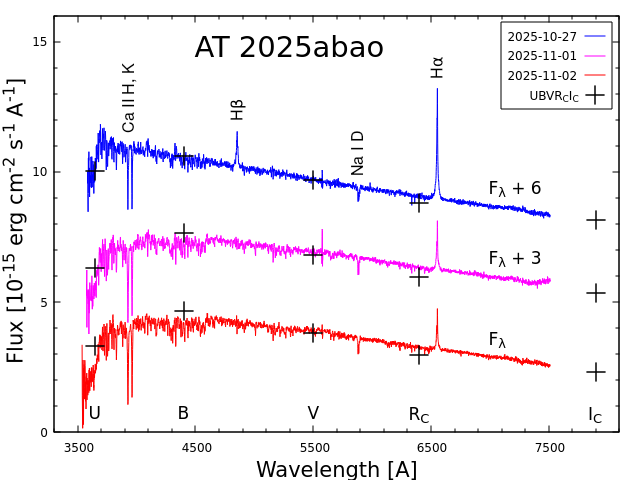
Here we report on our monitoring of AT 2025abao with UBVRcIc photometry
(using the 60 cm telescope operated by AsISAS, and the 50 cm
Ritchey-Chretien telescope of the Kislovodsk Observatory of INASAN),
and with optical spectroscopy carried out with the 2.5 m telescope
at the Caucasian Mountain Observatory of SAI (spectral range of
350-750 nm, and resolution of 1300 to 2500 in the shortwave to
longwave channel). An example of our spectra compared with our nearest
photometric flux-points is shown at http://www.ta3.sk/~astrskop/atel_nov2025/at2025abao_spectrum.png .
The continuum resembles that produced by an F-type star. Its evolution
from our first (2025-10-27.855 UT) to the last (2025-11-02.881 UT)
spectrum suggests a cooling of the star's pseudophotosphere. This
is supported by the fading fluxes of the hydrogen lines
(the H-beta line completely disappeared on 2025-11-01.997 UT), and
is consistent with the photometric evolution: AT 2025abao reached its
maximum at U = 15.09 during October 26-28, 2025, followed by a decrease
until our last measurement on 2025-11-01.79 UT at U = 15.37, while
the brightness in the Rc/Ic filters was gradually increasing from
14.95/14.55 mag at our first observation (2025-10-24.98 UT) to
14.64/14.21 at our last observation. This behavior of AT 2025abao's
radiation is similar to that of red novae (see also Taguchi and Maeda,
2025; Atel #17468), but further observations, especially in the infrared,
are needed to support this possibility. This work was supported by
the Slovak Research and Development Agency under the contract
No. APVV-24-0160, and by a grant of the Slovak Academy of Sciences,
VEGA No. 2/0003/25.
Spectra of AT 2025abao