Spectroscopic observations of the WZ Sge-type Dwarf Novae TCP J03173646+7459318 and TCP J20522886+1637203
ATel #17460; Vitaly Neustroev, Veeti Kaikkonen, Aino Lasanen (University of Oulu), Niilo Koivisto (University of Turku)
on 28 Oct 2025; 23:07 UT
Credential Certification: Vitaly Neustroev (vitaly@neustroev.net)
Subjects: Optical, Cataclysmic Variable, Transient, Variables
Two new candidates of WZ Sge-type Dwarf Novae were recently discovered by Xingming Observatory Sky Survey (XOSS). TCP J03173646+7459318, whose quiescent counterpart is of g=20.7+-0.05 mag (Gaia DR3 547882246076001536, G=20.63), was found to be at mag 13.8+-0.2CV on 2025 September 21.8. Another transient, TCP J20522886+1637203, was discovered on 2025 October 08.6 at 12.7+-0.02CV mag. Pan-STARRS1 shows a faint blue star of g=22.02+-0.02 mag at this location. This object has not been detected by Gaia. Tonny Vanmunster reported photometric time-resolved observations of both transients (vsnet-outburst 31562 and vsnet-alert 28112). He concluded that TCP J03173646+7459318 and TCP J20522886+1637203 are new WZ Sge-type dwarf novae with superhump periods of 86.4 and 81.6 min, respectively.
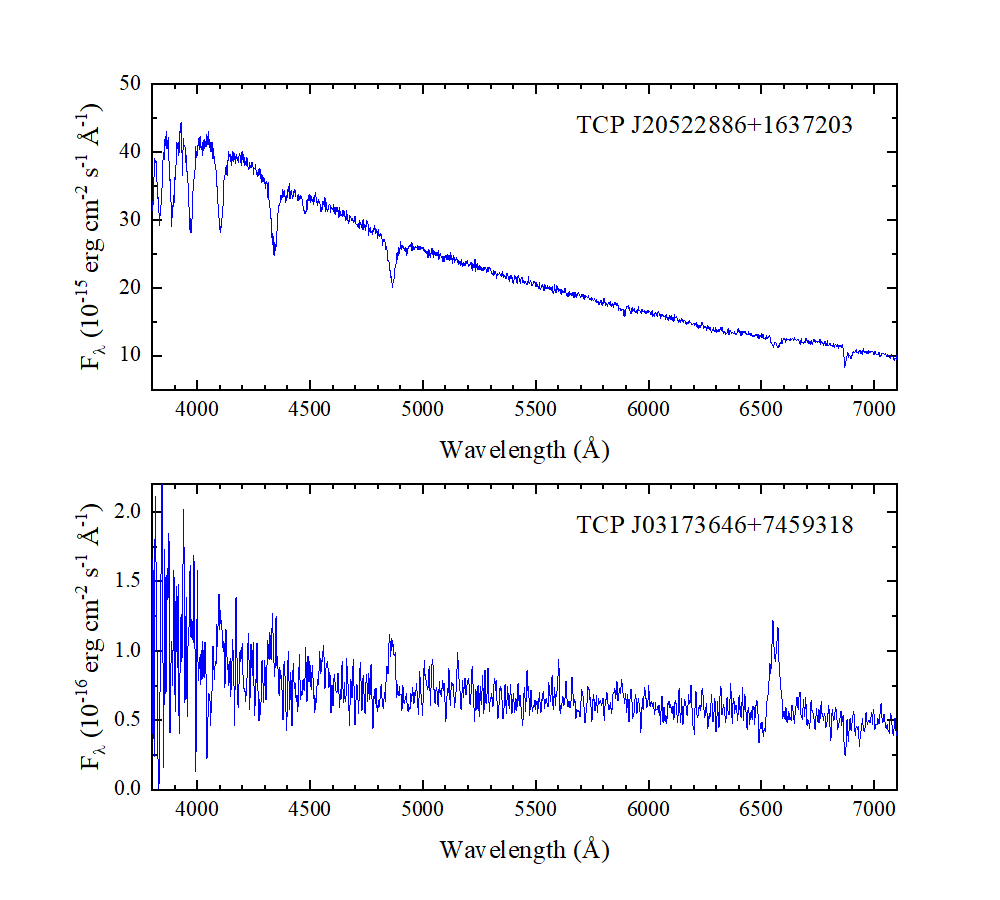
We observed these objects on 2025 October 24 with the ALFOSC imager and spectrograph at the Nordic Optical Telescope (NOT) on La Palma. We acquired single images through the V filter and obtained spectra with grism #7 and a slit width of 1 arcsecond, which provides a spectral resolution of R~650 in the spectral range 3650-7110 Angstrom. A single spectrum with an exposure time of 480 seconds was obtained for TCP J03173646+7459318, while for TCP J20522886+1637203, we acquired two spectra with exposure times of 300 seconds.
We found that the superoutburst of TCP J03173646+7459318 has ended and the object is heading towards quiescence, currently having V=19.35+-0.03 mag. Its spectrum exhibits double-peaked emission lines of hydrogen. Although there is also a sign of broad Balmer absorption features from the underlying accreting white dwarf, a relatively low signal-to-noise ratio does not allow us to claim it with certainty. TCP J20522886+1637203 is still in outburst, having the measured magnitude V=15.62+-0.01. Its spectrum is typical for a WZ Sge-type dwarf nova in outburst, showing the broad absorption troughs of the Balmer and neutral helium lines with weak emission cores. Thus, we conclude that the spectral characteristics of both objects, together with their photometric behaviour reported by Vanmunster, are consistent with being dwarf novae of the WZ Sge type.
The data presented here were obtained with ALFOSC, which is provided by the Instituto de Astrofisica de Andalucia (IAA) under a joint agreement with the University of Copenhagen and NOTSA.
The spectra of TCP J03173646+7459318 and TCP J20522886+1637203