Observations of an Asymmetric CN Coma in Interstellar Comet 3I/ATLAS
ATel #17416; Tony L. Farnham, Lori M. Feaga, Quanzhi Ye, Michael S. P. Kelley, Jessica M. Sunshine (University of Maryland)
on 23 Sep 2025; 19:02 UT
Credential Certification: Tony Farnham (farnham@astro.umd.edu)
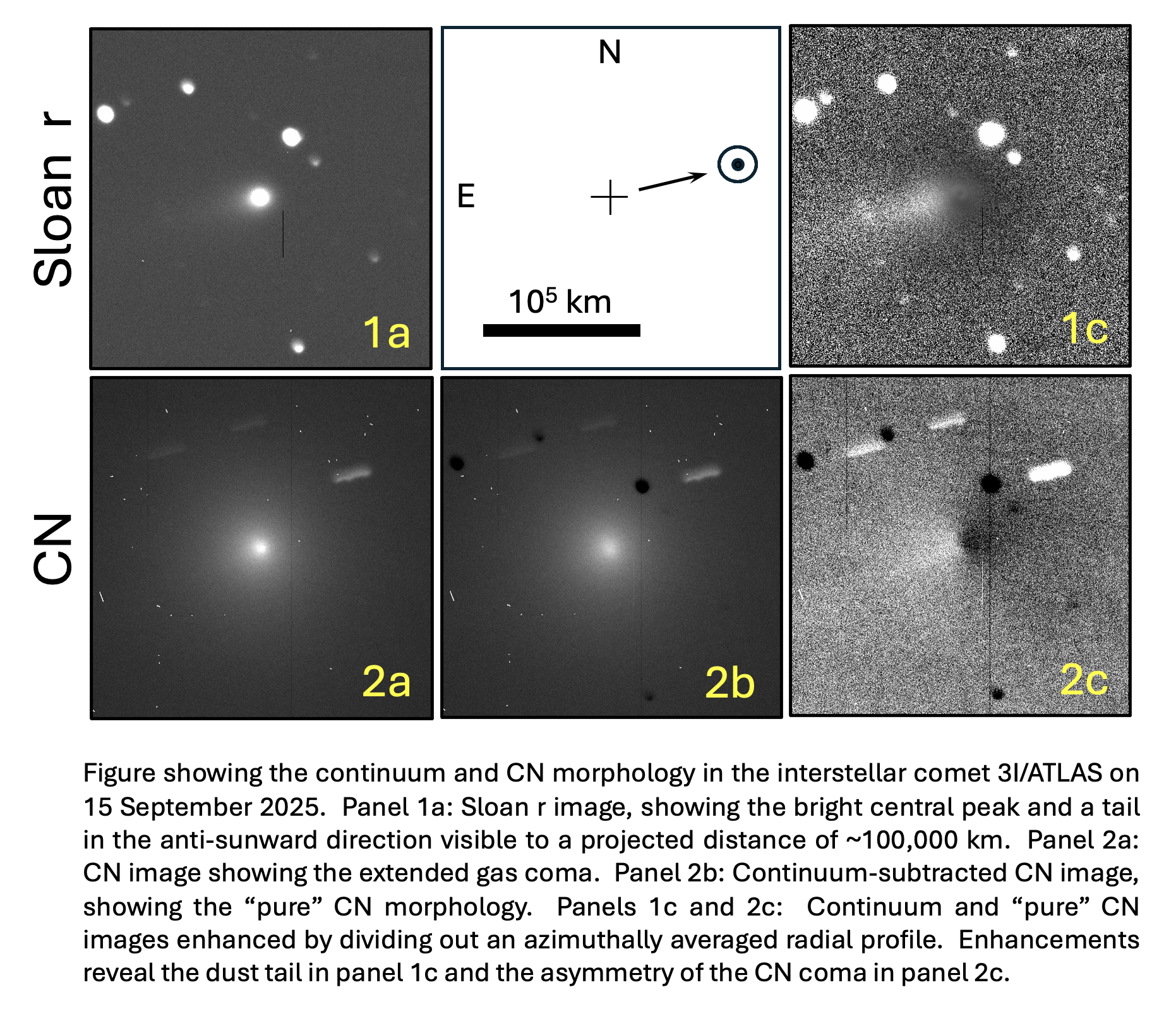
We report on observations of the interstellar comet 3I/ATLAS obtained with
the Large Monolithic Imager at the Lowell Discovery Telescope on 15 September
2025 (r=2.11 AU, Δ=2.54 AU). One 30-sec exposure was obtained with a
Sloan r filter, and four 300-s exposures were obtained using the HB
narrowband cometary CN filter (Farnham, Icarus 147, 180, 2000). The Sloan r
image, dominated by the dust continuum, reveals a sharp central condensation
with a faint tail in the anti-sunward direction, while the CN images show a
generally circular gas coma detectable to at least 180,000 km (see link for
images).
To produce a "pure" CN image, we registered and coadded the four CN
images and then performed a crude continuum removal by registering and
subtracting out the Sloan r image, scaled to the central peak of the CN
image. Scaling was adjusted manually until the CN remained smooth over its
peak after subtracting out the continuum. (We note that regardless of the
level of scaling, the continuum removal had no effect on the shape of the
extended gas coma.)
We then enhanced both the r and "pure" CN images by dividing
out azimuthally averaged radial profiles to remove the bright central peaks
and expose any low level asymmetric components. The enhanced r image
highlights the dust tail, which extends out to ⁓100,000 km (50 arcsec).
The enhanced CN image reveals a broad asymmetry that is brighter in the
anti-sunward direction. This asymmetry, which is centered on the dust tail,
indicates that at least some of the CN emission may arise from the dust
grains.
CN Asymmetry Figure