The fourth giant flare of Cygnus X-3 in 2024
ATel #16738; S. A. Trushkin, A. V. Shevchenko, N. N. Bursov, N. A. Nizhelskij, P. G. Tsybulev (SAO RAS, Russia)
on 27 Jul 2024; 10:27 UT
Credential Certification: Sergei Trushkin (satr@sao.ru)
Subjects: Radio, X-ray, Gamma Ray, >GeV, Binary, Black Hole
Referred to by ATel #: 17605
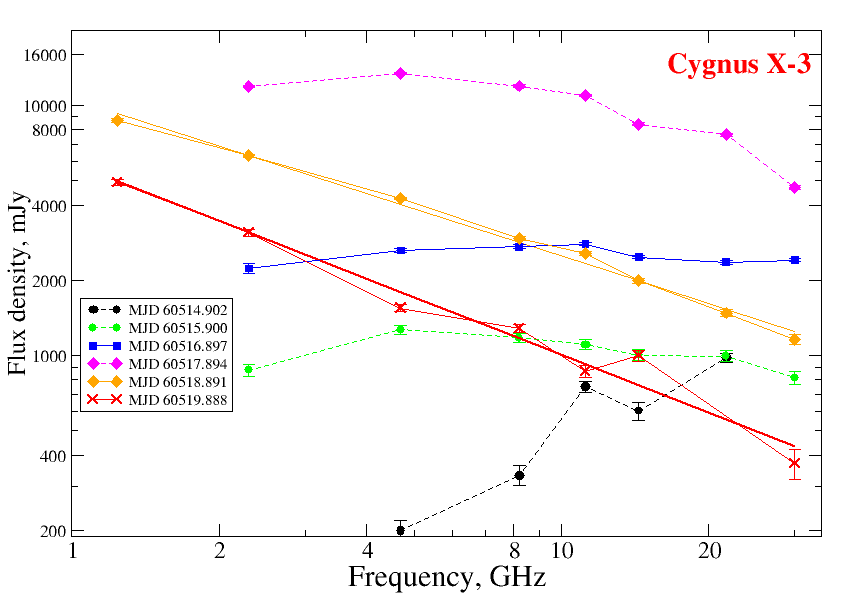
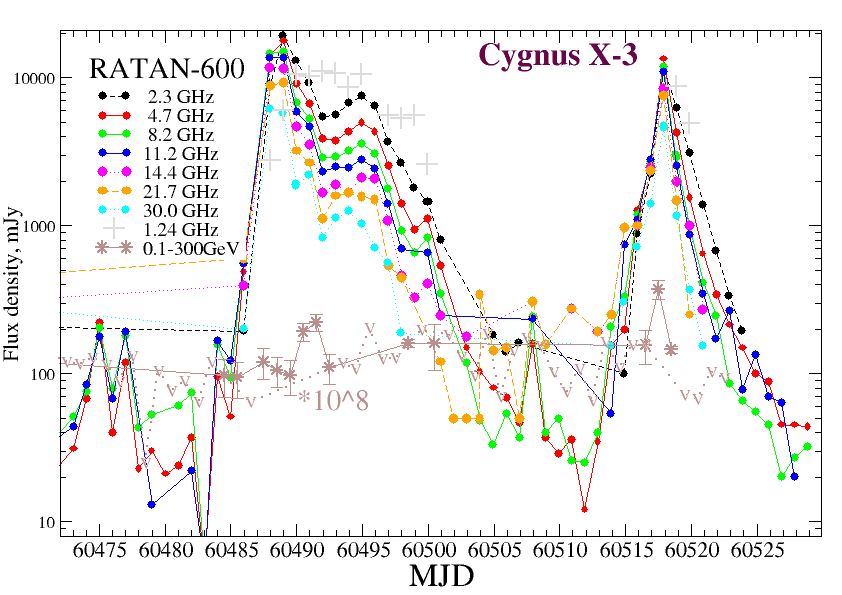
We continue the long-term multi-frequency monitoring of the Galactic microquasars with the RATAN-600 radio telescope almost daily in 2024 at 1.24-30 GHz. Already we have detected the activity from the microquasar Cygnus X-3 on 13-29 February, 27 March - 1 May, and 25 June - 16 July with maxima fluxes 15-20 Jy at 2.3-4.7 GHz. Again on 24 July Cyg X-3 entered in flaring state. Today 27 July the flux increased up to 14 Jy at 4.7 GHz. The evolution of spectra came from optically thick one with spectral index alpha = +1.0 (S ~ nu^alpha) (on 24 July) to almost flat spectra with alpha = -0.2 and 0.0 (25 and 26 July respectively) and at last to usual optically thin spectrum with alpha = -0.53 on 27 July. Thus the flux have increased from 10 mJy on 21 July to 14 Jy at 4.7 GHz on 27 July. All four giant flares occur within long period of the very low hard X-ray state at 15-50 keV, named by a hyper-soft state, according to the Swift/BAT and MAXI public domain data. The gamma-ray flux at 0.1-300 GeV was detected by Fermi observatory during first eight days of the last flare. As we found before from giant flares in 2019 in the third (June) flare was probably characterized by two events: first one with a fast increase and with a fast decrease, and second one with a slow grow and a slow fall. Both such events followed the exponential law of decay. The evolution of the flares evolved from optically thick to optically thin mode at frequencies lower 2.3 GHz. See daily spectra during the July flare here .
The light curves at 1.2-30 GHz during the June and July flares from Cyg X-3 in 2024